Money Laundering Examples: 12 Real Cases and Everyday Schemes (2026)
What money laundering looks like in real life: simple examples, 12 real cases from HSBC to Binance, and the everyday schemes compliance teams watch for.
Money laundering is making "dirty" money from crime look like it came from a legal source.
A simple example: a drug dealer runs cash through a restaurant, adds it to the day's sales, and deposits it as if customers paid it. Now the money looks like normal business income.
Real cases range from small (a "money mule" passing stolen money through their bank account) to huge (banks fined billions for letting cartels move money through their accounts).
What is money laundering?
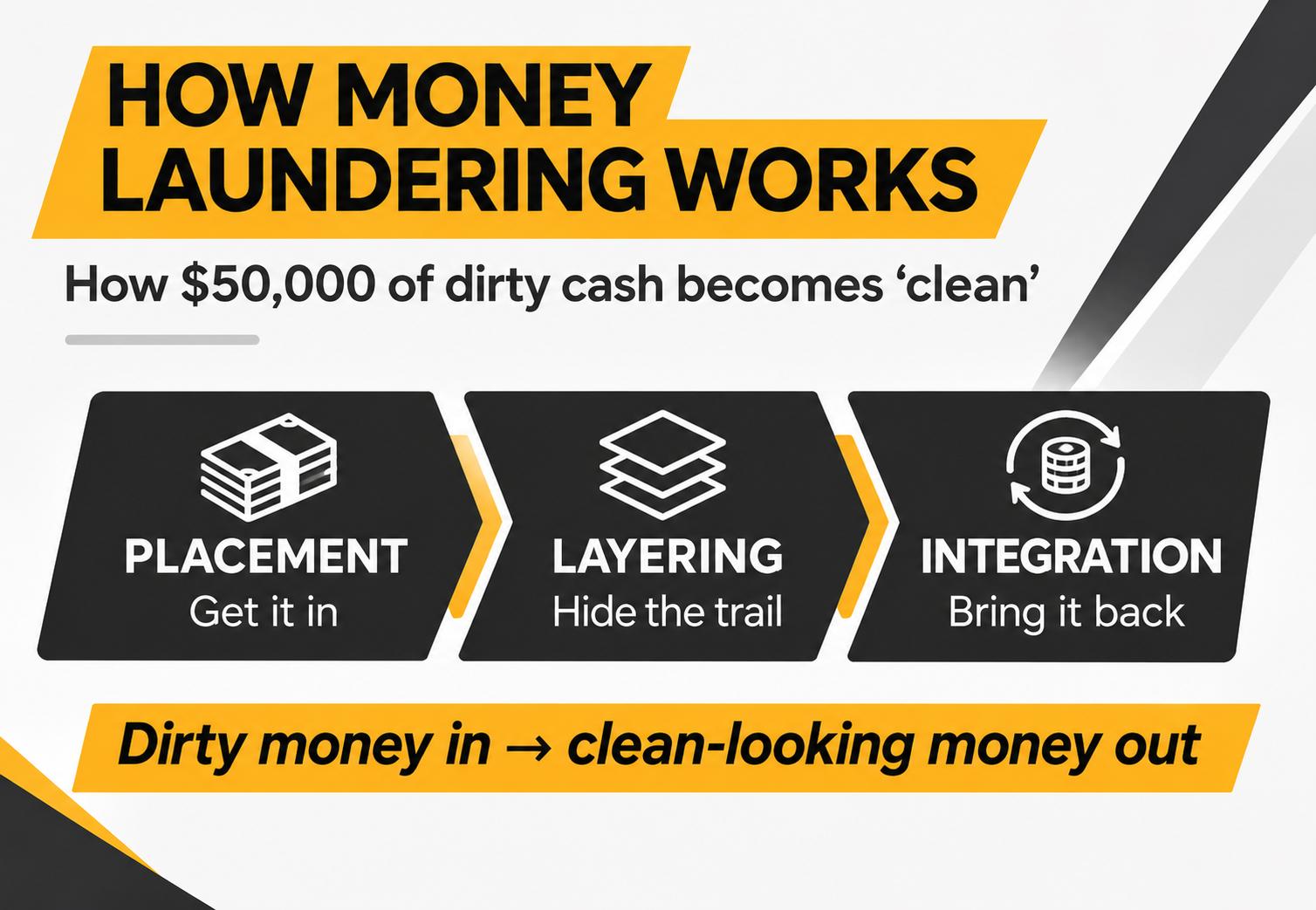
Criminals can't easily spend large amounts of crime money. Banks ask questions, and big cash deposits get reported. So they "clean" it in three steps:
- Placement: get the dirty money into the financial system (for example, depositing cash in small amounts).
- Layering: move it around to hide where it came from (transfers, shell companies, crypto).
- Integration: bring it back as "clean" money (a house, a business, a salary).
More on each step in the 3 stages of money laundering.
5 simple examples of money laundering
| Example | How it works |
|---|---|
| The restaurant | Cash from crime is added to the till and reported as sales. |
| The small deposits ("smurfing") | $50,000 in cash is split into many deposits under $10,000 to avoid reports. |
| The money mule | Someone is paid (or tricked) to let stolen money pass through their bank account. |
| The house | Criminal cash buys a property, which is then sold. The sale money looks clean. |
| The crypto hop | Stolen crypto is swapped between coins and wallets to hide its trail, then cashed out. |
12 real money laundering cases
Banks
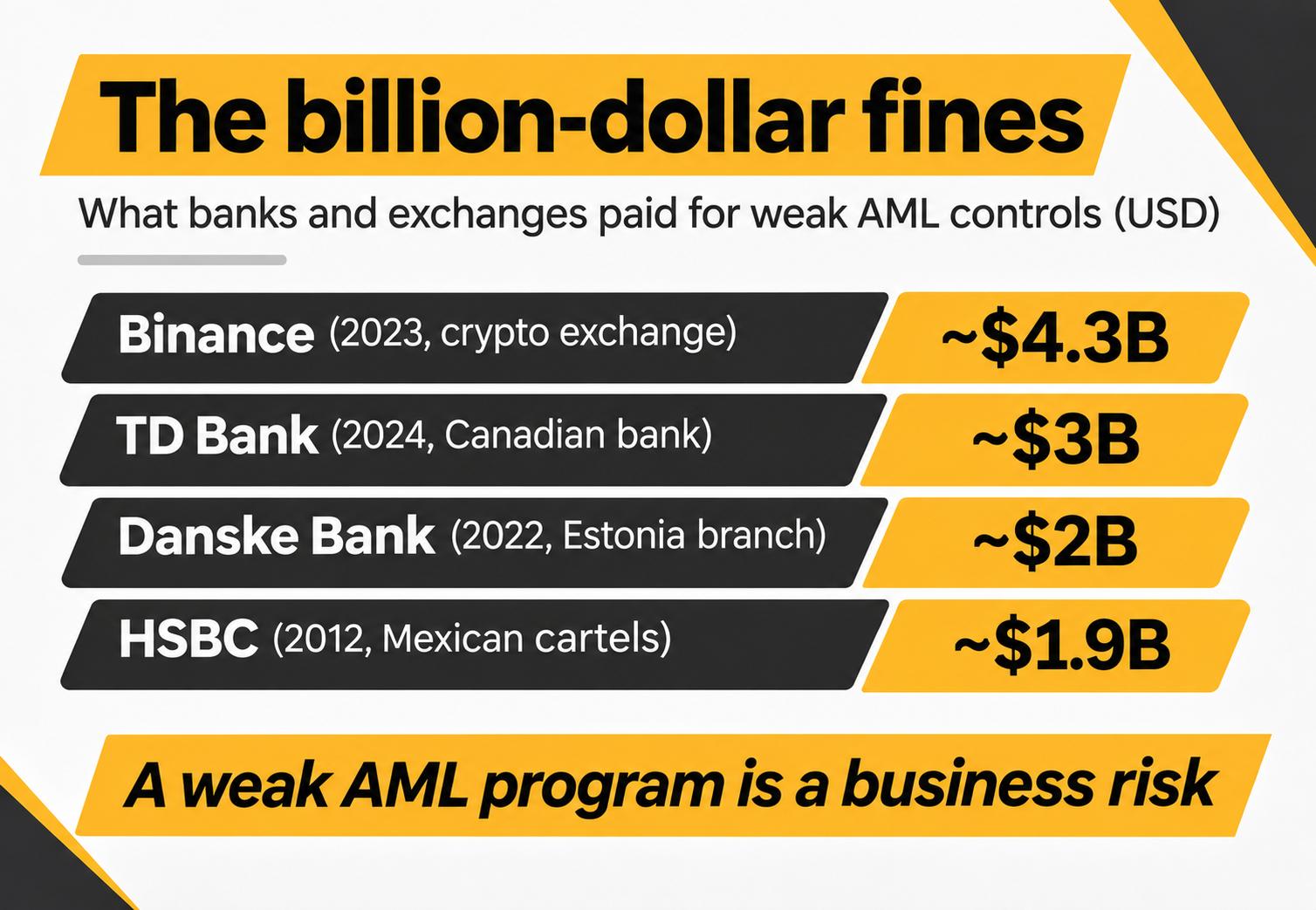
1. HSBC (2012). HSBC agreed to pay about $1.9 billion to US authorities after weak controls let Mexican drug cartels move at least $881 million through its accounts. Lesson: a weak AML program is a business risk, not just a paperwork gap.
2. Wachovia (2010). Wachovia paid $160 million after failing to properly monitor about $378 billion in transfers from Mexican currency exchange houses, some of which carried drug money. Lesson: high-risk money services clients need real monitoring.
3. Danske Bank (2007–2015). About €200 billion in suspicious payments flowed through the Estonian branch of Denmark's largest bank, much of it from non-resident clients. In 2022 Danske pleaded guilty in the US and agreed to pay about $2 billion. Lesson: a small branch can create a giant risk.
4. TD Bank (2024). TD pleaded guilty in the US and agreed to pay about $3 billion. Its US unit failed to monitor most transactions, and networks laundered more than $670 million through its accounts. It's one of the largest AML penalties ever, against a Canadian bank. Lesson: monitoring has to keep up with how big the bank is.
Crypto
5. Binance (2023). The world's largest crypto exchange agreed to pay about $4.3 billion for US anti-money laundering and sanctions failures. Its founder pleaded guilty to failing to maintain an effective AML program. Lesson: crypto companies face the same AML rules as banks.
6. Bitfinex hack (2016–2022). Hackers stole about 120,000 bitcoin from the Bitfinex exchange in 2016. A New York couple was arrested in 2022 for laundering it through thousands of transactions, fake identities and crypto swaps. Both pleaded guilty. Lesson: the blockchain keeps a permanent trail.
7. Liberty Reserve (2013). A Costa Rica-based digital currency service that let users open accounts with little ID. US prosecutors said it laundered more than $6 billion. Its founder was sentenced to 20 years in prison. Lesson: weak ID checks attract criminals.
Shell companies and secrecy
8. 1MDB (Malaysia). US authorities say more than $4.5 billion was taken from Malaysia's state fund and laundered through shell companies and bank accounts, then spent on real estate, art and even a Hollywood film. Goldman Sachs later paid more than $2.9 billion to settle related charges. Lesson: know who's really behind a company.
9. The Panama Papers (2016). A leak of 11.5 million documents from law firm Mossack Fonseca showed how shell companies were used to hide who owned money, including in some laundering and tax evasion cases. Lesson: this is why regulators now ask who really owns a business (beneficial ownership).
10. The "Russian Laundromat" (2010–2014). Investigators say about $20 billion was moved out of Russia using fake debts. Companies "owed" each other money, Moldovan courts approved the debts, and the money flowed through Moldovan and Latvian banks into Europe. Lesson: paperwork can look legal and still be fake.
Canada
11. The "Vancouver model" (BC casinos). Large amounts of cash, often in $20 bills, were brought into BC casinos and exchanged for chips. Investigators linked this to drug money and underground banking. BC's Cullen Commission (final report 2022) found money laundering was a serious problem in the province's casinos, real estate and luxury goods. Lesson: cash-heavy industries need strong checks.
12. Real estate in Canada. The same Cullen Commission found laundering also ran through BC real estate, where buyers could hide behind companies, trusts and nominees. FINTRAC now lists real estate as a key money laundering risk. Read FINTRAC says real estate is a money laundering risk. Lesson: property is one of the easiest places to "park" dirty money.
Everyday money laundering schemes to watch for
These are the methods compliance teams see most often:
- Structuring ("smurfing"): many cash deposits just under $10,000. In Canada, cash of $10,000 or more must be reported to FINTRAC.
- Cash-heavy businesses: car washes, restaurants, salons and convenience stores mixing dirty cash with real sales.
- Money mules: people recruited online ("easy work from home!") to receive and forward money.
- Trade-based laundering: invoices that overprice or underprice goods to move value across borders.
- Shell companies: businesses with no real activity, used to hide who owns the money.
- Real estate: buying property with dirty cash, often through companies or relatives.
- Crypto: swapping coins, using mixers, or cashing out through unregistered exchanges.
- Underground banking: informal transfer systems that move money without it crossing borders.
- Gift cards and prepaid cards: buying cards with cash, then reselling them.
For the warning signs your team should spot, see the top 10 AML red flags.
What anti-money laundering (AML) looks like in practice
An anti-money laundering example: a currency exchange notices a customer making several $9,500 cash deposits in a week. The pattern looks like structuring, so its compliance officer files a suspicious transaction report with FINTRAC.
That's AML in action. Businesses that handle money stop laundering by:
- checking who their customers are (KYC)
- watching for unusual activity
- reporting large cash and suspicious transactions to FINTRAC
- training staff and appointing a compliance officer (what is a CAMLO?)
Money services businesses (MSBs) are on the front line. Before you work with one, check it's registered on the MSB registry. If you're starting one, read our guide to the MSB license in Canada.
Need help building an AML program that would catch these schemes? Talk to AML Incubator.
FAQs
What is money laundering, with an example?
Money laundering is making criminal money look legal. Example: a criminal deposits drug cash into a restaurant's bank account as "sales", and it comes out as normal business profit.
What are the 3 stages of money laundering?
Placement (getting the money in), layering (hiding where it came from) and integration (using it as clean money).
What is the most common type of money laundering?
Cash-based schemes, such as structuring deposits and running cash through businesses, are among the most common. Crypto and trade-based laundering are growing fast.
What is the biggest money laundering case ever?
By size, Danske Bank is one of the largest: about €200 billion in suspicious payments went through its Estonian branch. By penalty, Binance (about $4.3 billion) and TD Bank (about $3 billion) are among the largest.
Is money laundering a crime in Canada?
Yes. It's a Criminal Code offence, with up to 10 years in prison. Businesses covered by the PCMLTFA must also have an AML program and report to FINTRAC.
What's an example of anti-money laundering?
A bank spotting a customer splitting cash into deposits under $10,000 and filing a suspicious transaction report with FINTRAC.