Bill S-8 Explained: Crypto ATM Ban, $10,000 Cash Limit and New MSB Rules (2026)
Canada's new Bill S-8 targets crypto ATMs, large cash payments and risky MSBs. Here's what's in it, when it could apply, and what businesses should do now.
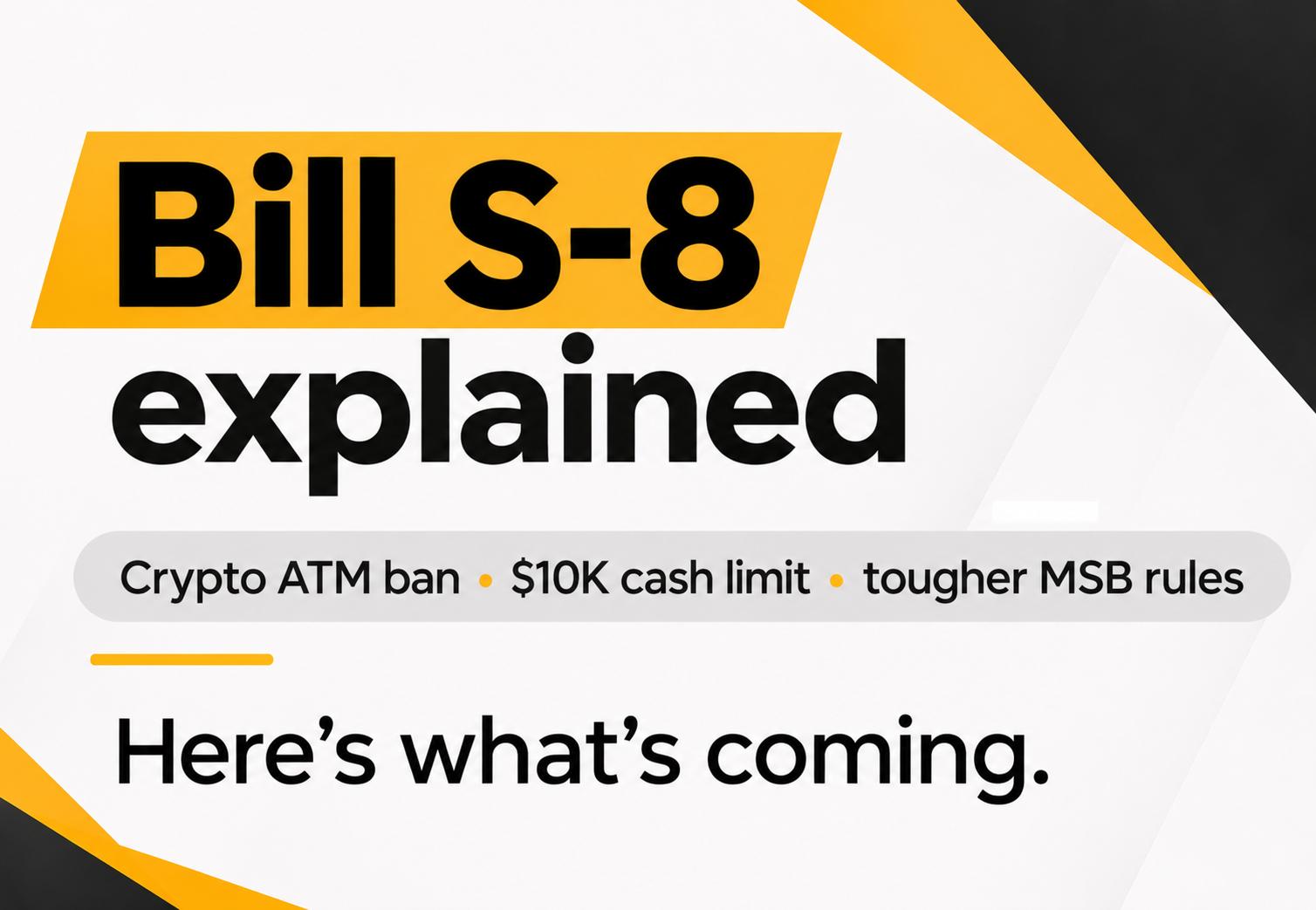
Bill S-8, the Combatting Financial Crimes and Drug Trafficking Act, is a federal bill introduced in the Senate on November 3, 2026.
If passed, it would:
- make it a crime to run a crypto ATM without a provincial licence
- cap crypto ATM use at $1,000 per person per 24 hours
- generally bar businesses from accepting $10,000 or more in cash
- give the Finance Minister and FINTRAC new powers to refuse, revoke or pause MSB registrations
- let police share information with banks and other reporting entities to fight money laundering
It is not law yet.
As of November 2026, it's at second reading in the Senate.
Bill S-8 at a glance
| Full name | Combatting Financial Crimes and Drug Trafficking Act |
| Introduced | November 3, 2026, in the Senate |
| Sponsor | Senator Pierre Moreau |
| Status | Second reading in the Senate (not law yet) |
| Main law it changes | Proceeds of Crime (Money Laundering) and Terrorist Financing Act (PCMLTFA) |
| Also changes | Canada Post Corporation Act, PIPEDA |
| Who it affects most | Crypto ATM operators, MSBs, businesses that take cash, banks and credit unions |
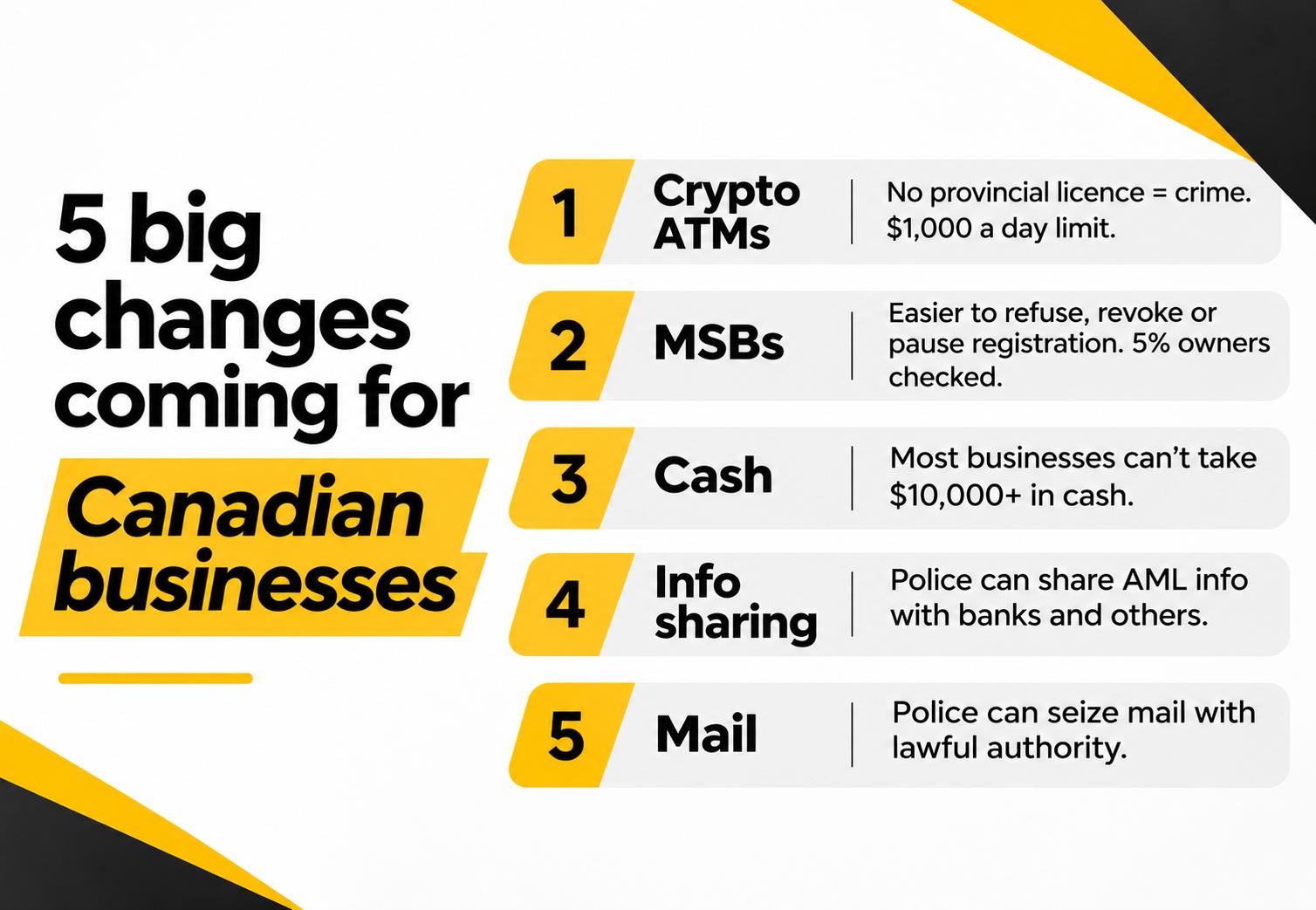
1. Crypto ATMs: a ban, plus a $1,000 daily limit
This is the biggest change.
The government says studies link 85% to 98% of crypto ATM transactions to illicit activity, and estimates Canadians lost $142 million to $284 million to crypto ATM fraud in 2024.
The ban: it would become a criminal offence to operate a crypto ATM unless the operator holds a provincial or territorial licence and the machine is in that province.
According to legal summaries of the bill, this could also reach businesses that host the machine, people who load cash into it, and anyone who knowingly supports an unlawful machine.
New rules for crypto ATMs that remain:
- $1,000 limit per person in any 24 hours
- ID verification for every user
- Records of every transaction
- Reports to FINTRAC on transactions, customers and digital wallets
- Machine information filed with FINTRAC
- Travel rule information for virtual currency transfers
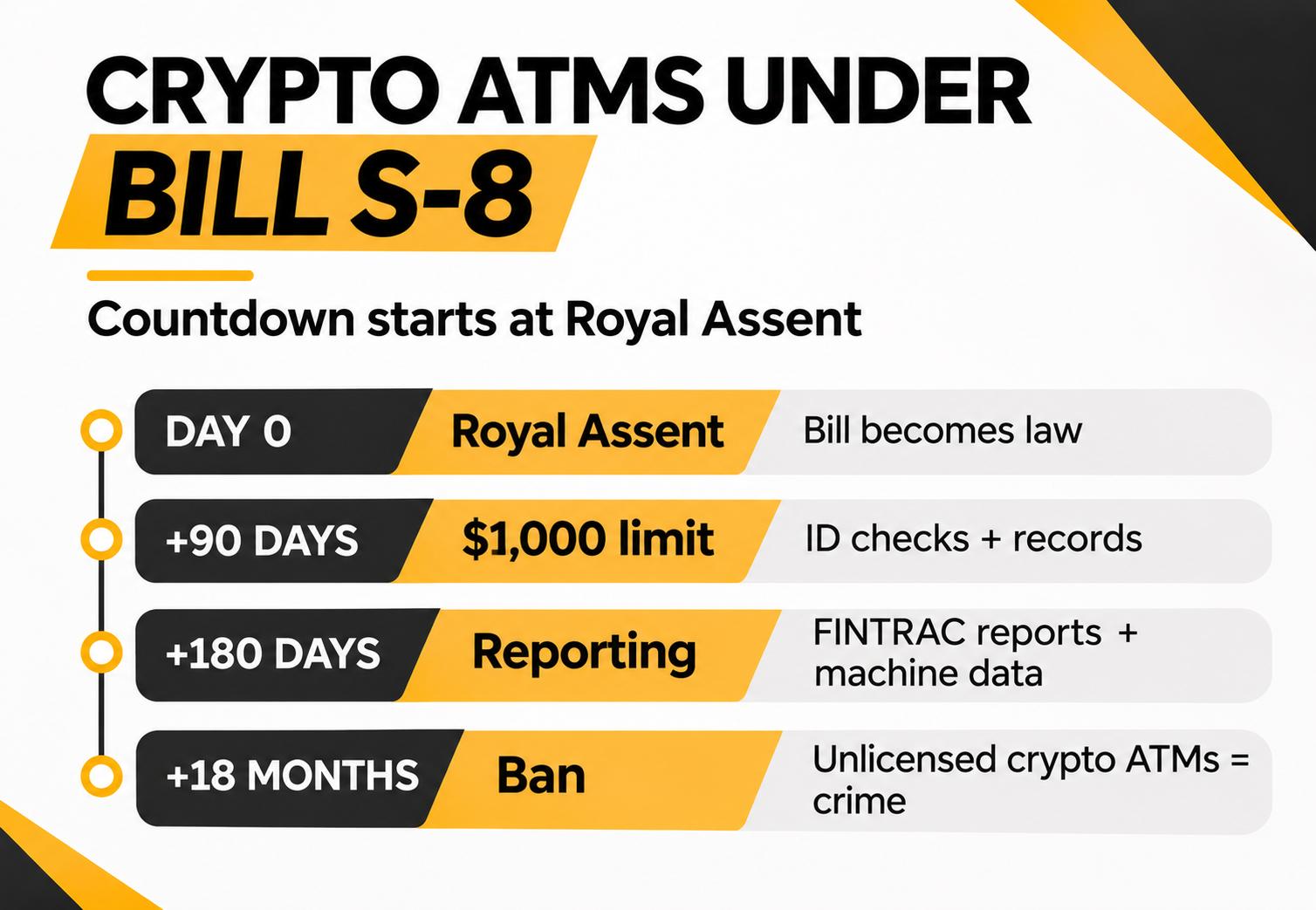
Proposed timing (after Royal Assent):
| When | What starts |
|---|---|
| 90 days | Records, ID checks and the $1,000 limit |
| 180 days | Reporting to FINTRAC and machine data |
| 18 months | The ban on unlicensed crypto ATMs |
Legal summaries of the bill describe penalties of up to $5 million and five years in prison for serious offences.
Running a crypto ATM business? Read Three paths forward for Canadian crypto ATM operators.
2. MSBs: tougher registration with FINTRAC
Bill S-8 gives the government and FINTRAC more power to keep risky money services businesses out:
- New ministerial powers: the Minister of Finance could direct FINTRAC to refuse or revoke an MSB's registration for national security or financial system integrity reasons.
- Registration pauses: the Minister could temporarily suspend new registrations or renewals for all MSBs, or for a specific type of business.
- More grounds to refuse or revoke, including when a business hasn't made real progress on a FINTRAC compliance order, still has the problem that got it refused or revoked before, or lost its payment service provider registration under the RPAA for national security reasons.
- Criminal record checks would reach anyone owning 5% or more of an MSB (down from 20%).
- More information up front: new MSBs would have to tell FINTRAC when they start operating, how they're financed and what services they offer.
- Transaction limits: regulations could temporarily limit or ban certain domestic transactions, and ministerial directives could require enhanced due diligence.
What it means: "register and figure it out later" gets much harder.
Ownership, funding and compliance history will be checked more closely.
See our FINTRAC MSB registration checklist and what happens with a FINTRAC MSB revocation.
3. A $10,000 cash limit
Businesses, professionals and groups that collect public donations would generally be barred from accepting $10,000 or more in cash, whether in one payment or a series of related payments.
- "Cash" means coins and bank notes, Canadian or foreign. Cheques, cards and crypto aren't included.
- Banks and credit unions (deposit-taking institutions) are exempt, and other exceptions may be added by regulation.
- Third-party cash deposits (cash put into someone else's account by a person who isn't the account holder or authorized on it) would be restricted.
These cash measures were first proposed in Bill C-2 in 2025.
Read more in Canada's AML overhaul: what Bill C-2 means.
4. Information sharing with police
Banks and other reporting entities would get clearer authority to receive and use information from law enforcement and government to detect money laundering, terrorist financing and sanctions evasion. Reporting entities acting in good faith would be protected from liability. This supports the public-private partnership launched in February 2025.
5. Canada Post and the mail
Police could search and seize mail when they have lawful authority under the Criminal Code, the Controlled Drugs and Substances Act or the Cannabis Act. The goal is to stop drugs and other illegal goods moving through the post. Postal inspectors still couldn't open letters.
What businesses should do now
The bill could still change before it passes, but the direction is clear. Start now:
- Crypto ATM operators: check whether your province offers a licence, and plan for the $1,000 limit, ID checks and FINTRAC reporting.
- MSBs: list everyone who owns 5% or more, and make sure your ownership, funding and services records are up to date.
- Any business that takes cash: find where you accept large cash payments, and plan how you'll stop at $9,999.
- Anyone under a FINTRAC compliance order: fix it now. Unresolved orders could become grounds to lose your registration.
- Banks and credit unions: review accounts held by crypto ATM operators and MSBs, and plan for third-party cash deposit limits.
Not sure how Bill S-8 affects you?
Book a call with AML Incubator or see our FINTRAC MSB registration services.
FAQs
What is Bill S-8?
A federal bill, the Combatting Financial Crimes and Drug Trafficking Act, introduced in the Senate on November 3, 2026. It targets crypto ATMs, large cash payments, risky MSBs and drug trafficking through the mail.
Is Bill S-8 law yet?
No. As of November 2026, it's at second reading in the Senate. It must pass the Senate and the House of Commons and get Royal Assent.
Are crypto ATMs being banned in Canada?
Unlicensed ones would be. Under Bill S-8, operating a crypto ATM without a provincial licence would become a crime 18 months after the bill becomes law. Licensed machines could keep running with a $1,000 daily limit and ID checks.
What is the $10,000 cash limit in Bill S-8?
Most businesses, professionals and fundraisers couldn't accept $10,000 or more in cash in one payment or a series of related payments. Banks and credit unions are exempt.
How does Bill S-8 affect MSBs?
The Finance Minister and FINTRAC could refuse, revoke or pause registrations more easily, criminal record checks would cover 5% owners, and new MSBs would have to give more information.
Who sponsored Bill S-8?
Senator Pierre Moreau, in the Senate.
This article is based on Bill S-8 as introduced on November 3, 2026. Details may change as the bill moves through Parliament. We'll update you as it does.