How Many Bitcoins Are There? Supply, Left to Mine & Last Bitcoin (2026)
Bitcoin has a hard cap of 21 million. Here's how many exist now, how many are left to mine, how many are lost, and when the last one arrives.
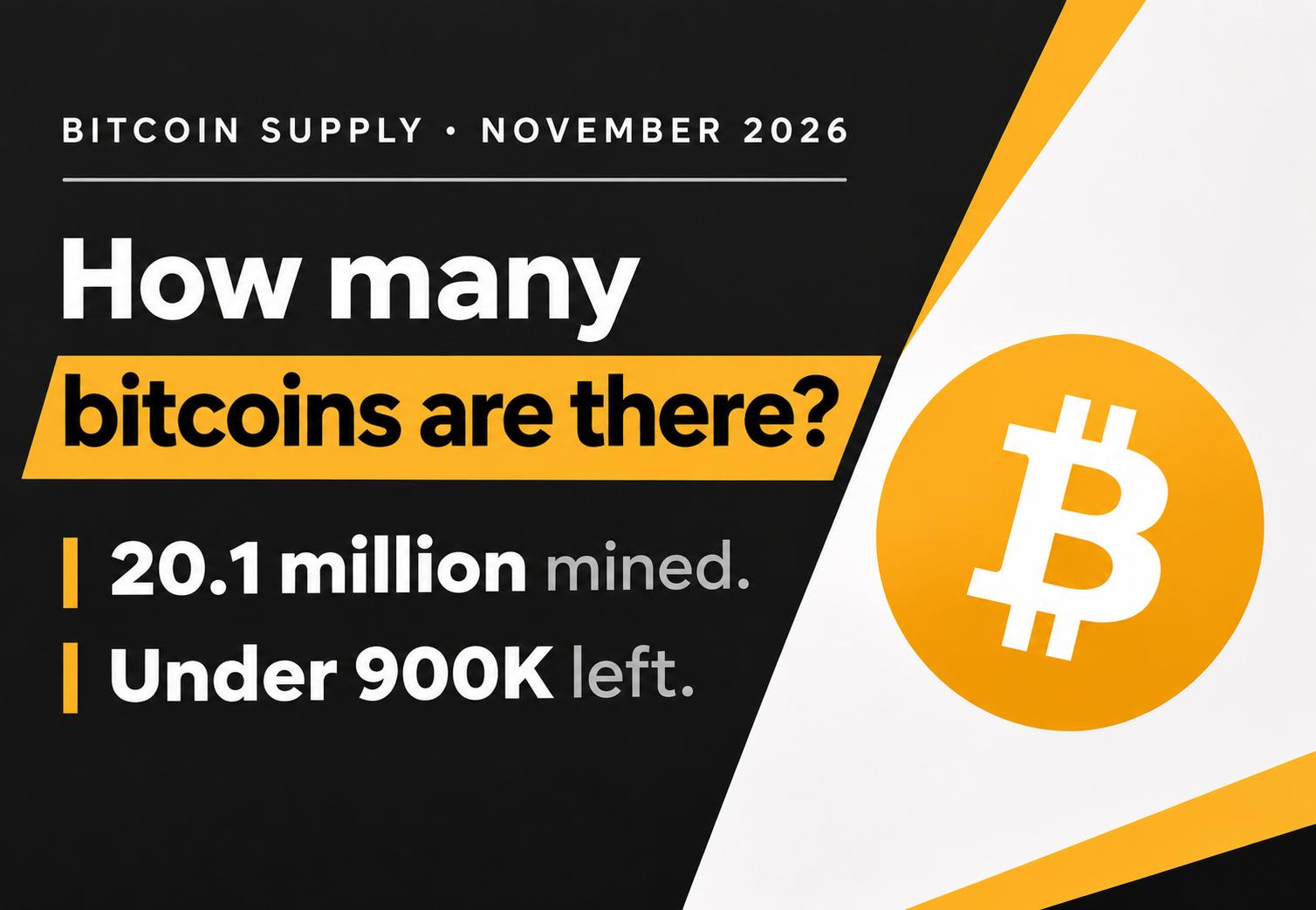
There are about 20.1 million bitcoins in existence as of November 2026, out of a fixed maximum of 21 million. That means about 95.8% of all bitcoin has already been mined and fewer than 900,000 are left. New bitcoins are created at about 450 a day, the pace halves every four years, and the last fraction of a bitcoin is expected around 2140. Millions of the coins already mined are probably lost forever.
Want the live number? Our Bitcoin Clock and halving countdown updates in real time.
Bitcoin supply at a glance (November 2026)
| Number | |
|---|---|
| Maximum supply | 21,000,000 BTC |
| Mined so far | about 20.11 million BTC |
| Share mined | about 95.8% |
| Left to mine | about 890,000 BTC |
| New bitcoins per block | 3.125 BTC |
| New bitcoins per day | about 450 BTC |
| 20 millionth bitcoin mined | March 9, 2026 |
| Next halving | around April 2028 |
| Last bitcoin mined | around 2140 |
| Estimated lost bitcoins | about 2.3 to 3.7 million |
Why is there a 21 million limit?
Bitcoin's creator, Satoshi Nakamoto, built the limit into the code in 2009. Unlike dollars, no central bank can print more. The cap comes from two rules:
- The block reward started at 50 BTC. Miners who add a new block get newly created bitcoin.
- The reward halves every 210,000 blocks (about every four years). This is the bitcoin halving.
Add up 50 + 25 + 12.5 + 6.25 … across every halving and you get just under 21 million. Because of rounding in the code, the true maximum is about 20,999,999.98 BTC.
How many bitcoins have been mined?
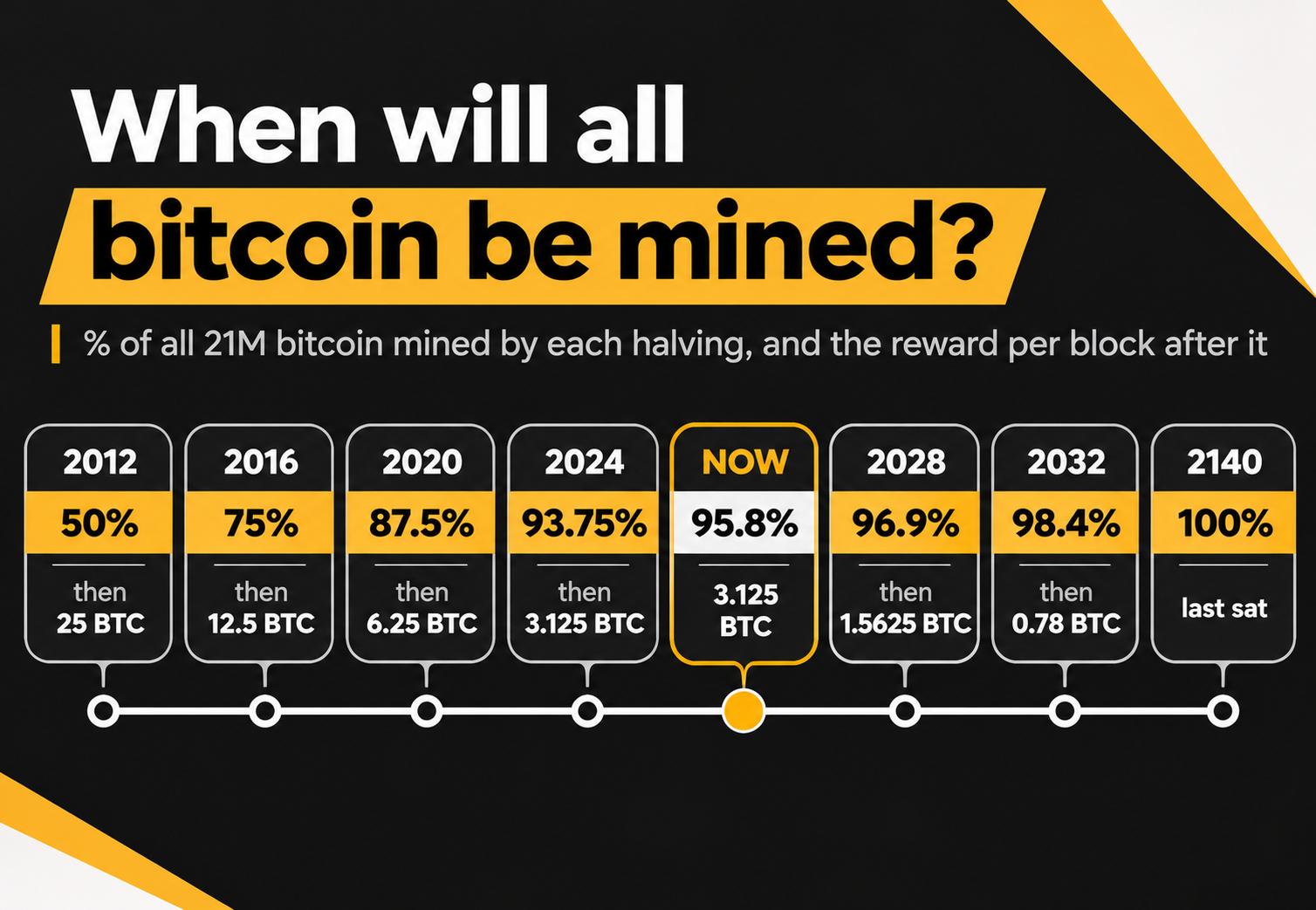
About 20.11 million as of early November 2026. Here's how the supply has grown with each halving:
| Era | Reward per block | Bitcoins created | Total by the end |
|---|---|---|---|
| 2009–2012 | 50 BTC | 10.5 million | 10.5 million (50%) |
| 2012–2016 | 25 BTC | 5.25 million | 15.75 million (75%) |
| 2016–2020 | 12.5 BTC | 2.625 million | 18.375 million (87.5%) |
| 2020–2024 | 6.25 BTC | 1.3125 million | 19.6875 million (93.75%) |
| 2024–2028 (now) | 3.125 BTC | 656,250 | 20.34 million (96.9%) |
| 2028–2032 | 1.5625 BTC | 328,125 | 20.67 million (98.4%) |
Half of all bitcoin was mined in the first four years. The last few percent will take more than a century.
How many bitcoins are left to mine?
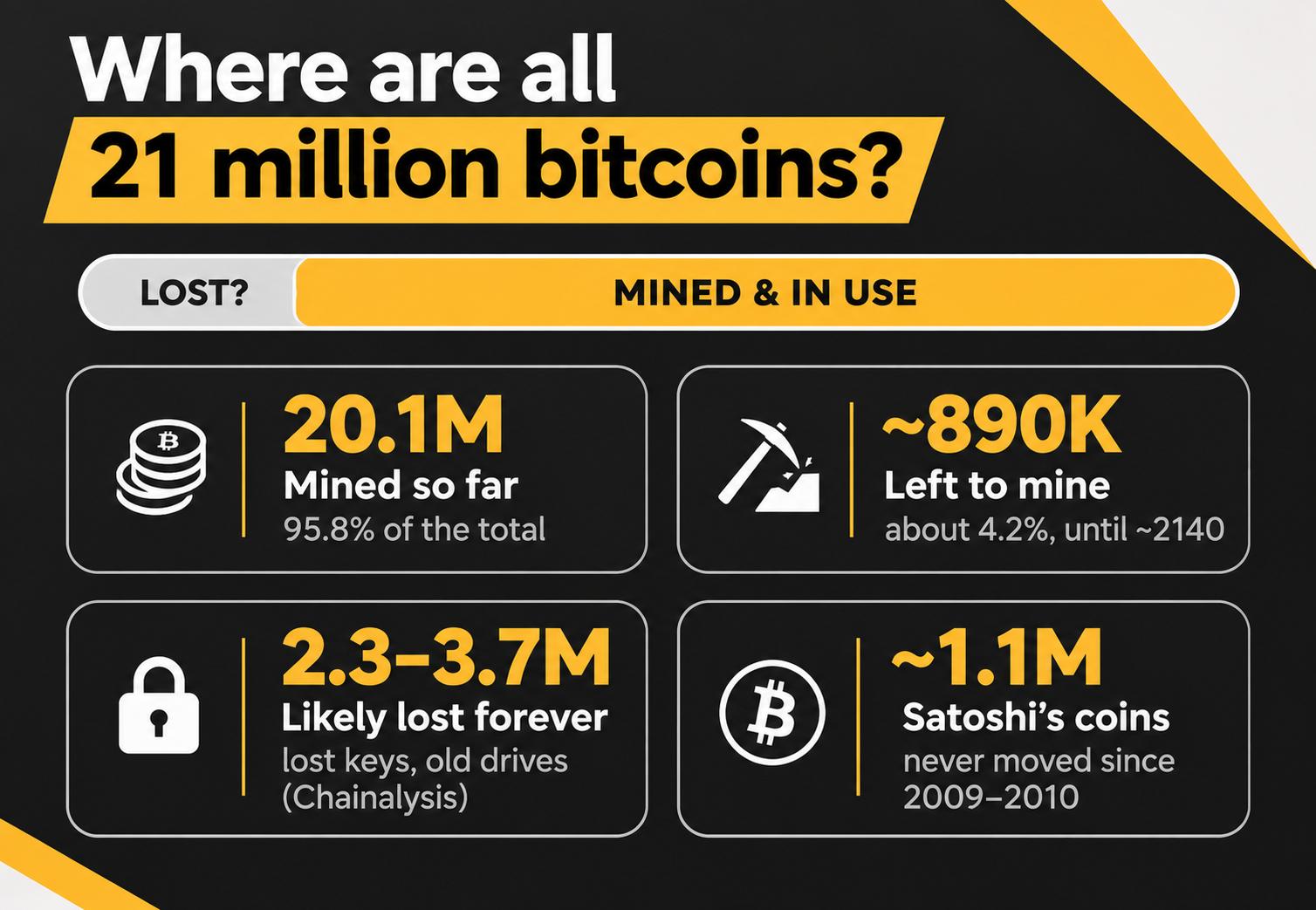
About 890,000 BTC are left as of November 2026. That's around 4.2% of the total.
At today's rate of about 450 new bitcoins a day, that sounds quick. But the rate halves in 2028, again in 2032, and so on. So the final 890,000 will take until around 2140.
When will all bitcoin be mined?
Around the year 2140. Each halving cuts new supply in half, so the amount created gets tiny long before it reaches zero:
- By 2032: about 98.4% mined
- By 2036: about 99.2% mined
- By 2040: about 99.6% mined
- By about 2140: the last satoshi is created
How many bitcoins are lost?
Many coins that exist can never be spent. Their owners lost the private keys, threw away hard drives, or died without passing on access.
- Chainalysis estimated in 2020 that about 2.3 to 3.7 million BTC may be lost forever.
- About 1.1 million BTC is believed to belong to Satoshi Nakamoto and has never moved.
- The 50 BTC from the very first block (the "genesis block") can't be spent because of how the code works.
So the bitcoin that can actually be used is closer to 16 to 17.5 million, not 20 million.
How many satoshis are in a bitcoin?
100 million. A satoshi ("sat") is the smallest unit of bitcoin: 0.00000001 BTC. So the 21 million cap is really 2.1 quadrillion sats. That's why you can buy a small amount of bitcoin even when one coin costs a lot.
What happens when all bitcoins are mined?
Miners will stop getting new bitcoin. Instead, they'll earn only transaction fees paid by people sending bitcoin. That's already starting: fees are a growing share of miner income after each halving. Nobody knows for sure if fees alone will keep the network secure, but it's more than 100 years away.
Why the supply matters for crypto businesses (and compliance)
A fixed supply is a big reason bitcoin attracts investors, and also scammers. If you run a crypto exchange, ATM, or wallet business:
- Price jumps after halvings bring more new users, and with them more fraud, scams, and money laundering attempts.
- Lost coins that suddenly move after years can be a red flag. Old wallets "waking up" draw attention from blockchain analysts and regulators.
- Scams use scarcity as a pitch: "only a few bitcoin left, buy now." That's a classic warning sign. See our guide to spotting crypto scams.
- In Canada, crypto businesses must register with FINTRAC as a money services business and follow AML rules, including large virtual currency transaction reports. Here's our full AML checklist for crypto exchanges.
Need help setting up crypto compliance? Book a call with AML Incubator.
FAQs
How many bitcoins are there in total?
Bitcoin's maximum supply is 21 million. About 20.1 million are mined as of November 2026.
How many bitcoins are left to mine?
About 890,000 BTC, or roughly 4.2% of the total.
When was the 20 millionth bitcoin mined?
On March 9, 2026.
When will the last bitcoin be mined?
Around the year 2140, after more than 30 halvings.
How many bitcoins are mined per day?
About 450 BTC (144 blocks × 3.125 BTC). This drops to about 225 a day after the 2028 halving.
Can the 21 million limit change?
Only if most of the network agreed to change bitcoin's code, which is extremely unlikely. The cap is one of bitcoin's core rules.
How many people own a whole bitcoin?
Nobody knows exactly, because one person can have many wallets and exchanges hold coins for millions of users. With fewer than 21 million coins and billions of people, owning one whole bitcoin is rare.
Supply figures are as of November 2026 and change every block. Check our live Bitcoin Clock for the current number.