FINTRAC Says Real Estate Is a Money Laundering Risk
Real estate brokers, sales representatives, and developers are already FINTRAC reporting entities in Canada. Most of them have no idea how much scrutiny that puts them under, or how little it currently takes to fall short of it. Somewhere between $5 billion and $47 billion moved through Canadian real estate as dirty money in a single year, depending on whose estimate you trust. Real estate licensees in British Columbia filed as few as seven suspicious transaction reports a year, across an entire province, while that was happening. Both numbers are true at the same time. That's the problem.
How Big Is the Money Laundering Problem in Canadian Real Estate?
Large enough that it triggered a public inquiry. A B.C. expert panel estimated that roughly $5 billion moved through the province's real estate market in 2018 alone, part of a wider $7.4 billion laundered across the province that year, and pointed to a national estimate of around $47 billion laundered across Canada annually.
The same research linked real estate laundering to a roughly 5% increase in Metro Vancouver home prices.
That scale of money is why British Columbia ran the Cullen Commission, a multi-year public inquiry that spent 130 days hearing evidence specifically on how money laundering moves through the province, including real estate.
Despite the scale of the problem, B.C. real estate licensees filed as few as seven suspicious transaction reports a year between 2015 and 2021, across the entire industry, fewer reports in a year than a single mid-sized bank branch might file in a slow month.
Are Real Estate Brokers Legally Required to Follow AML Rules?
Yes, as of now.
Real estate brokers, sales representatives, and developers are reporting entities under Canada's Proceeds of Crime (Money Laundering) and Terrorist Financing Act.
That means brokers already have to verify the identity of clients and unrepresented parties, determine whether a third party is actually behind a transaction, keep records available on request within 30 days, and file reports for large cash transactions within 24 hours, along with reports on suspicious activity whenever there are reasonable grounds to suspect it.
Large virtual currency transactions carry that same 24-hour reporting requirement, which matters more every year as crypto-funded offers become less unusual.
Brokers need to record and verify name, address, phone number, occupation or the nature of the client's business, and date of birth for an individual client, and keep that information current in case anything changes.
Even when an agent handles the actual verification, the brokerage itself stays fully responsible if something goes wrong.
What Changed for Real Estate Brokers in October 2025?
The clearest change is that brokers and sales representatives must now verify the identity of any unrepresented party to a transaction.
Before this, a broker could reasonably treat the other side of a deal, someone without their own agent, as outside their identification obligations. That’s not the case anymore!
What Are the Common Red Flags in a Real Estate Transaction?
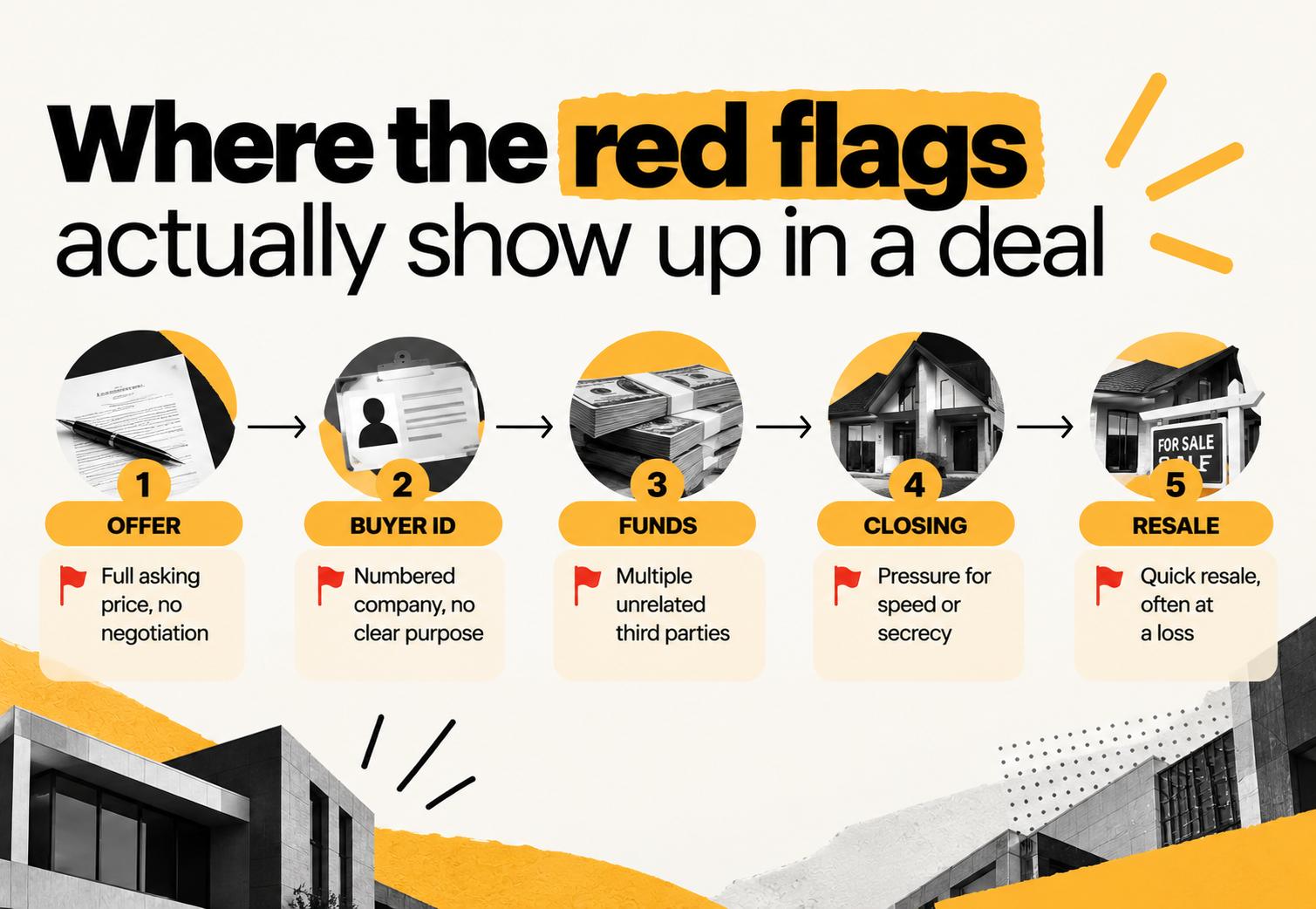
A few patterns show up repeatedly in the cases regulators and inquiries have flagged:
|
Red flag |
Why it matters |
|
Full asking price, no financing, no negotiation |
Fast, no-questions deals are a common laundering pattern |
|
Buyer is a numbered company with no clear purpose |
Makes it harder to identify who actually benefits |
|
Funds from multiple unrelated third parties |
A common way to obscure the real source of money |
|
Quick resale, often at a loss |
Can signal the goal was moving money, not profit |
|
Unusual pressure for speed or secrecy |
Legitimate buyers rarely need diligence rushed |
Picture a Condo Sale in Richmond
A buyer pays full asking price in cash through a numbered company, with no financing conditions and no inspection request. Eight months later, the same company resells the property at a small loss.
Nothing about that requires a criminal mastermind. It just requires nobody asking who actually owns the numbered company, either time.
What Should a Brokerage Do to Stay Compliant?
-
Name a compliance officer in writing, with real authority.
-
Check your client identification process against the October 2025 requirements, especially for unrepresented parties.
-
Review recent files for the red flags above, especially cash-heavy or fast-turnaround deals.
-
Train agents on what reasonable grounds to suspect actually means, since it's a lower bar than most assume.
-
Get an outside effectiveness review of whether your program would hold up.
For a broader look at what qualifies a business as a reporting entity under the Act, or the full list of red flags examiners look for across every sector, those cover the fundamentals this guide builds on.
FAQ
What is the Vancouver model?
It's a money laundering pattern where cash was cycled through casinos to build a clean paper trail, then reinvested into real estate. Casinos tightened controls after the pattern became public; real estate mostly hasn't, which is part of why the money kept moving there.
How much money has actually been laundered through Canadian real estate?
A B.C. government expert panel estimated around $5 billion moved through the province's real estate market in 2018 alone, part of a wider $47 billion estimated across Canada that year.
Do small brokerages need to comply too?
Yes. The obligation is based on the activity. A one-agent operation and a large firm face the same requirements, and there's no employee count or transaction volume threshold that exempts either one.
What happens if a brokerage doesn't file suspicious transaction reports?
The same penalty framework that applies to banks and MSBs applies to real estate reporting entities, including administrative monetary penalties for non-compliance. Firms that discover a backlog of missed filings usually need regulatory remediation to close the gap properly rather than quietly.
Is registering or enrolling with FINTRAC the same as being compliant?
No, and it's one of the most common misconceptions reporting entities have about FINTRAC. Registration or enrolment records your details with FINTRAC. It doesn't mean your compliance program has been reviewed or approved. That happens separately.
Who should be responsible for AML compliance at a brokerage?
A named compliance officer with real authority to question or block a transaction.
Where can a brokerage get help building a compliance program?
AML Incubator works with real estate brokerages on compliance officer support and program reviews built specifically for AML obligations.
Get In Touch
If your brokerage has never had its AML obligations reviewed by someone outside the office, the gap the Cullen Commission described is worth checking before a regulator or a reporter finds it first.
CAMLO and MLRO Services: a named, qualified compliance officer with real authority, built for firms that can't justify a full-time hire.
AML Effectiveness Review: an independent look at whether your brokerage's program would actually hold up, not just whether a policy exists.
Enhanced Due Diligence Services: deeper diligence on the higher-risk deals real estate red flags actually point to.
Book a discovery call and we'll walk through where your brokerage actually stands.