The 2016 Real Estate Scandal Few Called Money Laundering
A real estate scandal from a decade ago rarely got called what it probably was. Reassigning a presale contract before closing is still legal, and it still moves ownership through exactly the kind of chain that makes layering money easy. Here's what that mechanic looks like, and why it matters more now than it did in 2016.

In 2016, a Vancouver real estate scandal made headlines because buyers were paying more than they realized and agents were collecting commission twice on the same unit. The coverage was about fairness, not laundering. Ten years later, assigning a contract is still legal, and the laundering angle still gets far less attention than it deserves.
A buyer signs a contract to purchase a pre-construction condo. Before the building is even finished, that contract gets resold, sometimes more than once, each time at a higher price. Whoever eventually shows up on closing day might have no traceable connection at all to the person who first signed.
What Actually Is Shadow Flipping?
Reselling a contract to buy a property, before the sale ever closes.
A buyer signs an agreement with an assignment clause (common in presale contracts, and easy to miss if you're not looking for it), which lets them transfer their right to purchase to someone else.
That new buyer can do the same thing again before the building's finished. Each reassignment adds a markup, and the original agent can collect a commission every single time.
What Actually Happened in Vancouver in 2016?
A Globe and Mail investigation put the practice in front of the public in early 2016, and the province moved fast after that. Reassigning a contract was legal then and still is now. What wasn't properly disclosed was licensees acquiring a client's home, assigning the contract to a third party, and keeping a markup the seller never knew existed.
The Real Estate Council of B.C. brought in an independent advisory group.
In March 2016, the province announced that new rules would require the seller's express consent for an assignment and return any profit to the homeowner, and the Globe and Mail covered the rules when they were unveiled.
Those rules were aimed at agents flipping clients’ homes. A 2018 commentary from UBC Allard law students noted that condo presale contracts were still unrestricted at that point.
Was Shadow Flipping Ever Actually Called Money Laundering?
Rarely, at least at first.
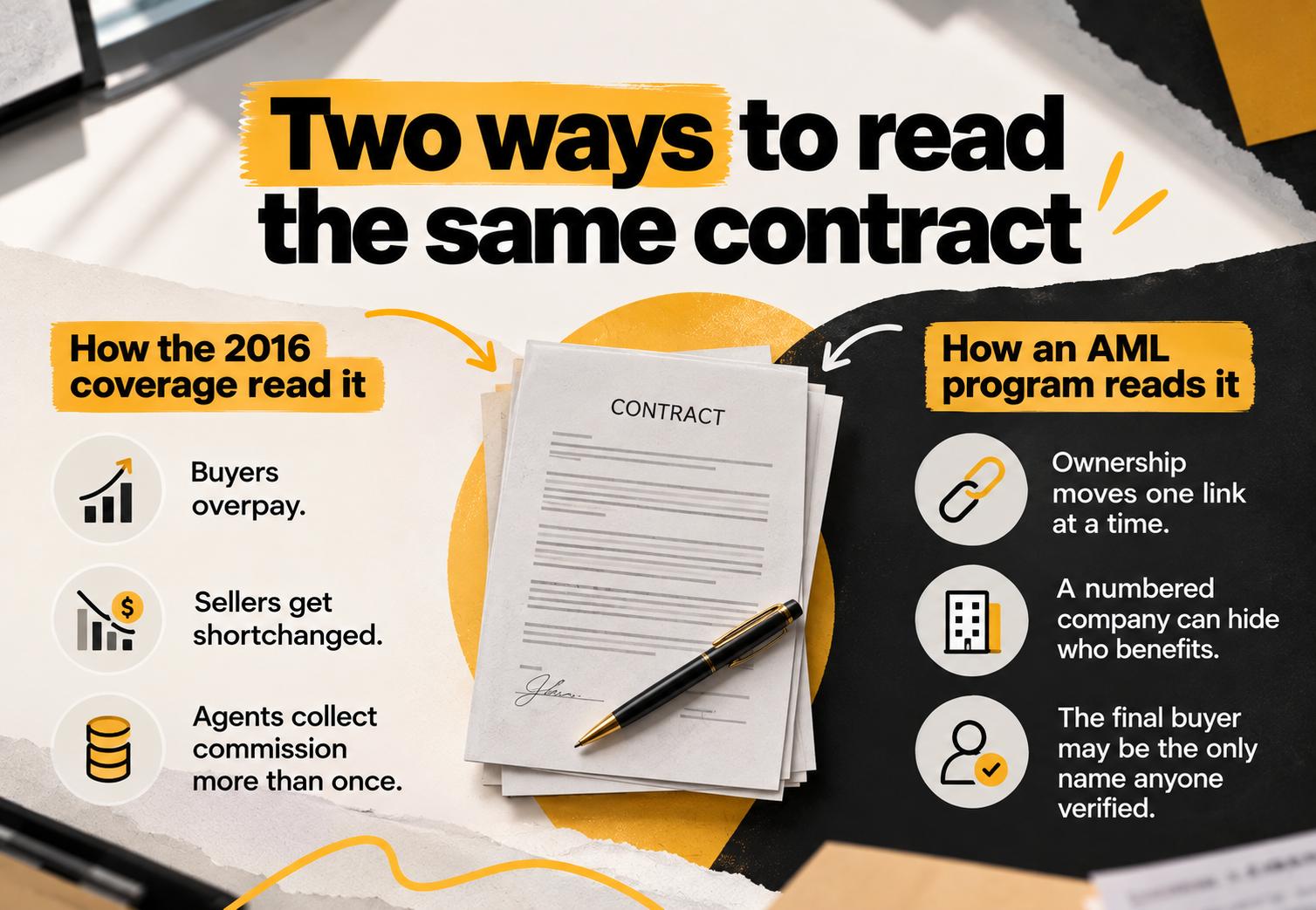
In 2016 this was a fairness story: buyers overpaying, sellers getting shortchanged, agents double-dipping. It was far from the thought of “laundering”. We haven’t found an enforcement action built on it.
But looking at just the mechanic, we see a lot. Layering, in money laundering terms, means moving funds repeatedly so the origin gets harder to trace. An assignment chain does that to ownership instead. Each resale puts one more link between the property and whoever first touched it, and unless somebody checks every single link, the final buyer can be an unverified person.
Why Is an Assignment Chain Such a Convenient Layering Tool?

Because every reassignment looks, on its own, like an unremarkable transaction. It doesn't draw the scrutiny a direct sale would. Slot a numbered company into one link of that chain, one with no public ownership record, and the person who actually benefits from the final sale can stay invisible through several perfectly legal transfers.
The 2018 commentary made the same point about presales: only the transfer of legal title from the developer to the final purchaser was registered with the land title office, so the names of people who flipped the contract in between often went unrecorded.
Put cash into that chain at any point and the price jump doesn't stand out, because assignment prices are expected to climb. A plain cash purchase gets no such cover. A large cash payment on a finished home is the first thing anyone notices.
A Normal Resale vs. an Assignment Chain
| Normal resale | Assignment chain | |
|---|---|---|
| Transactions before anyone takes possession | One | Could be several |
| Who verifies the final buyer's identity | The closing agent, once | Depends whether every link disclosed the reassignment |
| Visibility of the true source of the markup | Tied to one sale price | Spread across transfers that may never surface together |
| Who benefits from the price increase | The seller, by default | Whoever's holding the contract last, unless the rules say otherwise |
What Do Brokers Actually Have to Do About Assignment Sales Now?
A lot.
Brokers already have to verify the identity of unrepresented parties and figure out whether a third party is really behind a deal, and that applies to an assignee exactly as much as an original buyer. With beneficial ownership discrepancy reporting mandatory, a numbered company showing up midway through a chain stops being just an awkward disclosure gap. It becomes something with a reporting obligation attached, if the ownership details don't add up.
We haven't found FINTRAC guidance that uses the phrase "shadow flipping."
What Should a Brokerage Actually Do This Quarter?
- Flag every deal with an assignment clause for a closer look, not the standard file review.
- Confirm who's actually named at each reassignment, watching for numbered companies or anything with no visible ownership.
- Check what consent the contract requires for each assignment and that it's documented, rather than assumed because "that's just how it's done here."
- Treat a fast run of reassignments as a layering red flag, the same way you would anywhere else, instead of writing it off as normal presale-market behaviour.
- Get an outside effectiveness review of how your brokerage actually handles assignments specifically, since most reviews never look past standard resales.
A Presale Tower, Somewhere Outside Vancouver
A buyer puts down a deposit on a unit two years before completion. About eighteen months in, they assign the contract to a numbered company for a markup nobody at the brokerage thinks to question, because markups are just what happens in that building. Half a year later, that company assigns it again.
By the time someone actually moves in, three separate transactions have happened on paper, and the person who signed the original deposit has never once crossed paths with the person who ends up with the keys. Nobody planned it that way from the start. It just kept being nobody's job to ask.
FAQ
What is shadow flipping?
Reselling a contract to purchase a property, sometimes more than once, before the original sale closes, using an assignment clause in the purchase agreement.
Is shadow flipping illegal?
Reassigning a contract is legal in Canada. What B.C. went after in 2016 was licensees flipping clients' homes without the seller's consent or a share of the profit.
Was shadow flipping ever prosecuted as money laundering?
We haven't found a prosecution or a FINTRAC penalty that treats assignment sales themselves as the violation. It was handled through consumer-protection rules. FINTRAC has fined B.C. real estate brokerages for other AML failures, including a $275,385 penalty against LaBoutique Realty in 2022 for failing to file suspicious transaction reports, among other violations.
Do FINTRAC's rules cover assignment sales specifically?
Not by name, as far as we've found. The existing duties to verify identity, determine third-party involvement, and report beneficial ownership discrepancies apply to an assignment the same as any other transaction.
Why would a numbered company show up in an assignment chain?
It can keep the real beneficiary of the final sale invisible, since a numbered company's ownership isn't always disclosed at every point in the chain.
What should a brokerage actually change about how it handles presale deals?
Treat each reassignment as its own transaction requiring identity verification, not as a footnote inside one larger sale.
Get In Touch
If your brokerage handles presale or assignment transactions and nobody's looked at that pipeline through an AML lens specifically, that's worth closing before a numbered company turns up in a chain nobody thought to question.
AML Effectiveness Review: an independent look at how your brokerage actually handles higher-risk transaction types, assignment sales included.
CAMLO and MLRO Services: a named compliance officer with the authority to flag an assignment chain before it closes, not after.
Enhanced Due Diligence Services: deeper diligence on multi-party deals where the final buyer isn't the person who signed first.
Book a discovery call and we'll walk through where your brokerage actually stands.