Discrepancy Reporting Is Now Mandatory: How to Handle Beneficial Ownership Mismatches in Canada
Beneficial ownership discrepancy reporting in Canada is now a formal AML compliance obligation. Under FINTRAC’s regulatory framework, reporting entities must identify and report material discrepancies between beneficial ownership information provided by clients and information contained in official registries.
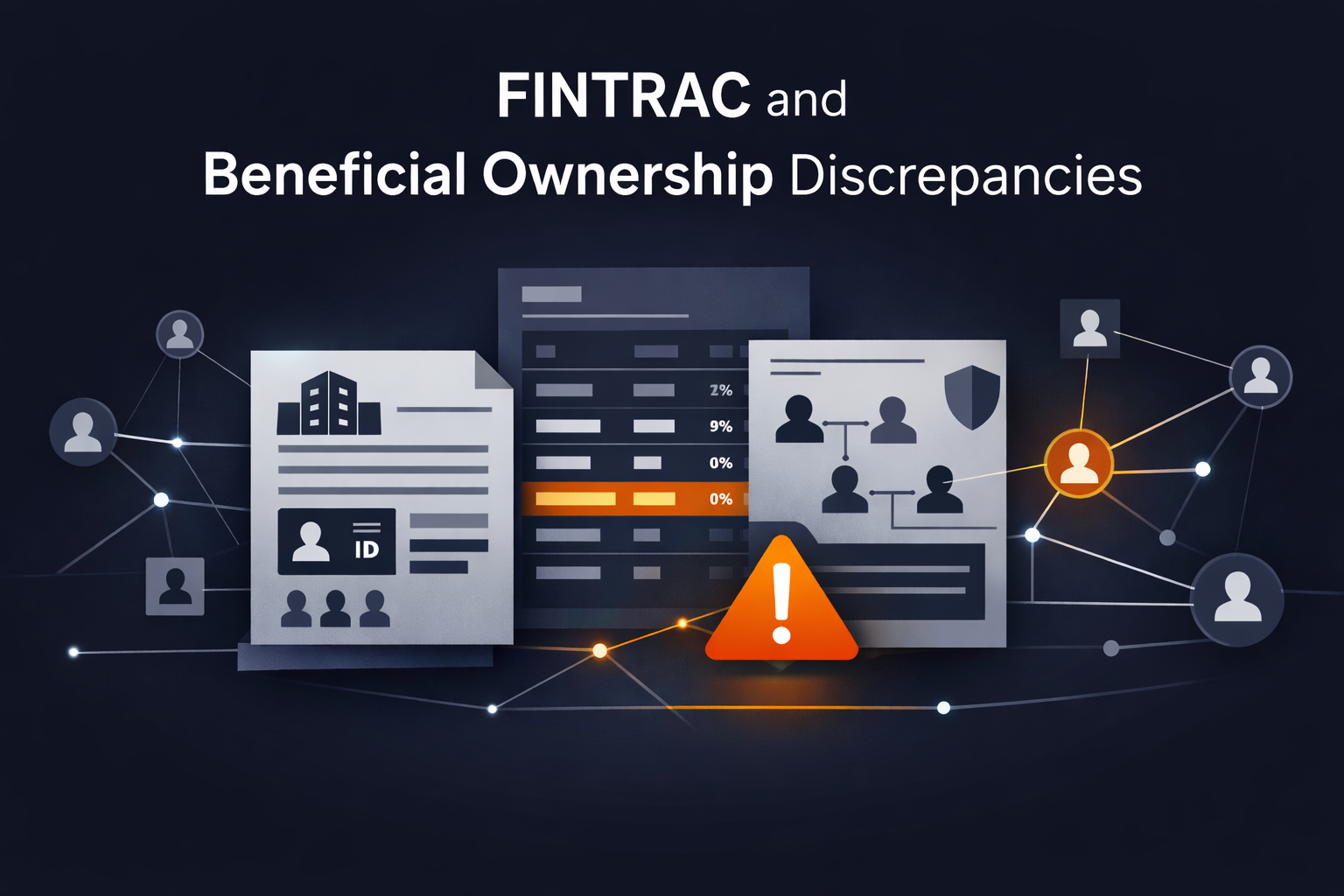
For Canadian money services businesses, fintechs, and crypto platforms, beneficial ownership discrepancy reporting is no longer optional or theoretical. FINTRAC now treats it as part of ongoing due diligence, AML governance, and program effectiveness. It is increasingly reviewed during examinations and enforcement actions.
This article explains how beneficial ownership discrepancy reporting works in Canada, when MSBs and other reporting entities must report, what FINTRAC expects in practice, and how to operationalize compliant procedures.
Where the Beneficial Ownership Discrepancy Reporting Obligation Comes From
Beneficial ownership obligations in Canada arise from the Proceeds of Crime (Money Laundering) and Terrorist Financing Act (PCMLTFA) and its regulations. These laws require reporting entities to identify, verify, and maintain accurate information on individuals who ultimately own or control their clients.
With the introduction of the federal beneficial ownership registry administered by Corporations Canada, regulators now expect reporting entities to actively compare client-provided ownership information against official registry data as part of ongoing customer due diligence.
Corporations Canada beneficial ownership information and discrepancy reporting overview:
https://ised-isde.canada.ca/site/corporations-canada/en/federal-incorporation/beneficial-ownership-information
FINTRAC has made clear that beneficial ownership verification is not limited to onboarding. It forms part of the risk-based approach required under Canadian AML law.
When material inconsistencies are identified, reporting entities are expected to act. Beneficial ownership discrepancy reporting is therefore a regulatory obligation, not a best practice.
What Is a Beneficial Ownership Discrepancy Under FINTRAC Rules
A beneficial ownership discrepancy exists when there is a material inconsistency between ownership or control information provided by a client and information contained in an official registry or other reliable source.
FINTRAC distinguishes between:
-
Minor clerical or formatting errors, and
-
Discrepancies that affect the identification of individuals who own or control an entity
Examples of reportable beneficial ownership discrepancies include:
-
A beneficial owner listed in the federal registry but not disclosed by the client
-
Material differences in ownership percentages
-
Individuals exercising control who are missing from client records
-
Control persons whose identity cannot be verified or conflicts with registry data
This obligation applies throughout the client lifecycle, not only at onboarding.
Which Entities and Registries Are In Scope
Beneficial ownership discrepancy reporting applies to FINTRAC reporting entities, including:
-
Money services businesses
-
Crypto MSBs and virtual asset service providers
-
Fintech payment service providers
If you are unsure whether your business qualifies as an MSB, Check here if you do.
You can also verify registration status using AML Incubator’s MSB Search tool.
FINTRAC’s official overview of who must report can be found on FINTRAC's website.
The primary registry reference is the federal beneficial ownership registry maintained by Corporations Canada. Provincial registries may also be relevant depending on the jurisdiction of incorporation.
For entities with foreign or complex ownership structures, FINTRAC expects reasonable measures. Cross-border ownership does not exempt reporting entities from discrepancy assessment.
When a Beneficial Ownership Discrepancy Becomes Reportable
A discrepancy becomes reportable when it is:
-
Material
-
Unresolved after reasonable measures
-
Relevant to ownership or control
Examples of reportable discrepancies include:
-
A different individual identified as a beneficial owner
-
Material inconsistencies in ownership percentages
-
Missing or unverifiable individuals exercising control
Examples that may be resolved internally include minor typographical errors or short-term timing differences supported by documentation.
Decision-making must be documented. FINTRAC examinations focus heavily on whether conclusions were reasonable and consistently applied, even when no report was ultimately filed.
What Counts as “Reasonable Measures” in Practice
FINTRAC does not expect perfection. It expects proportionate, documented effort.
Reasonable measures typically include:
-
Reviewing the federal beneficial ownership registry
-
Requesting clarification or supporting documentation from the client
-
Reviewing corporate filings and governance records
-
Using independent verification sources where appropriate
Reasonable measures do not require indefinite investigation. Delaying reporting in pursuit of complete certainty often increases regulatory risk rather than reducing it.
How Discrepancies Are Identified Across the Client Lifecycle
Beneficial ownership discrepancies may be identified:
-
During onboarding and initial KYC
-
During periodic reviews
-
Through enhanced due diligence
-
Following transaction monitoring escalations
-
During AML effectiveness reviews or FINTRAC examinations
Legacy clients represent a common risk area. Clients onboarded before registries became operational are not exempt from ongoing ownership verification.
This is closely tied to AML program effectiveness.
How and When to Report a Beneficial Ownership Discrepancy to FINTRAC
Reporting entities should maintain written procedures covering:
-
Internal escalation to the CAMLO or compliance officer
-
Verification steps taken
-
Documentation standards
-
Submission through FINTRAC reporting channels
-
Record retention requirements
FINTRAC’s MSB compliance overview on how to report this discrepancy.
Discrepancies must be reported promptly once identified and reasonably assessed. Ongoing remediation or client follow-up does not suspend reporting obligations.
Beneficial Ownership Discrepancy Reports vs Suspicious Transaction Reports
Discrepancy reports address data integrity and transparency.
Suspicious Transaction Reports address suspected money laundering or terrorist financing activity.
In some cases, both reports may be required.
For guidance on STR quality and regulator expectations, read this article.
Misclassification is a frequent FINTRAC examination finding.
Governance, Accountability, and CAMLO Oversight
FINTRAC expects beneficial ownership discrepancy handling to be embedded within an organization’s AML governance framework, not managed informally or on a case-by-case basis.
The CAMLO or designated compliance officer should:
Own discrepancy escalation and reporting decisions
The CAMLO should have clear authority to assess materiality, determine whether reasonable measures have been taken, and decide whether reporting is required. Escalation responsibility should be centralized and documented.
Ensure consistent application of procedures
Similar discrepancies should be handled in similar ways across the organization. FINTRAC examinations often focus on whether procedures are applied consistently rather than on individual outcomes.
Maintain clear audit trails
Records should show how discrepancies were identified, what steps were taken, and why a decision was made to report or not report. Poor documentation is commonly treated as a governance weakness during examinations.
In higher-risk cases or where discrepancies recur, FINTRAC may also expect evidence of senior management awareness.
How Discrepancy Reporting Fits Into a Risk-Based AML Program
Recurring beneficial ownership discrepancies often signal broader control weaknesses, including ineffective onboarding, weak review cycles, or insufficient documentation.
FINTRAC increasingly treats unresolved discrepancies as AML effectiveness issues rather than isolated errors. This is why discrepancy reporting is often reviewed alongside AML effectiveness reviews:
What FINTRAC Focuses on During Examinations
FINTRAC commonly assesses:
-
Whether written discrepancy procedures exist
-
Consistency of decisions across files
-
Timeliness of reporting
-
Documentation quality
-
Staff training and awareness
-
Use of systems and audit trails
For deeper examination insight, read this article
Why FINTRAC Cares About Beneficial Ownership Discrepancies
Corporate structures are frequently used to obscure ownership and control in financial crime. Registry integrity is therefore a national transparency priority.
Weak ownership controls undermine AML frameworks and increase systemic risk. Regulatory tolerance in this area continues to narrow, particularly for MSBs, fintechs, and crypto businesses.
Frequently Asked Questions
Do MSBs need to report beneficial ownership discrepancies in Canada?
Yes. Under FINTRAC requirements, MSBs must assess and report material discrepancies identified through reasonable measures.
What counts as a material beneficial ownership discrepancy?
Any inconsistency that affects identification of individuals who own or control an entity.
How quickly must discrepancies be reported to FINTRAC?
Promptly after identification and reasonable assessment.
Can a discrepancy trigger an STR?
Yes, if it appears deliberate or linked to suspicious activity.
Do legacy clients need to be reviewed?
Yes. Ongoing verification applies regardless of onboarding date.
Conclusion
Beneficial ownership discrepancy reporting is now a core AML obligation in Canada. Reporting entities that establish clear procedures, governance ownership, and documentation standards are better positioned to withstand FINTRAC examinations and reduce the risk of post-exam remediation.