Enrolling With FINTRAC Won't Make You Compliant. But Most People Think It Will.
Universal enrolment is coming, and most businesses about to fill out that form have never dealt with FINTRAC before. That inexperience shows up as five specific assumptions, all wrong, all common, and all worth fixing before the form is actually sitting in front of you.
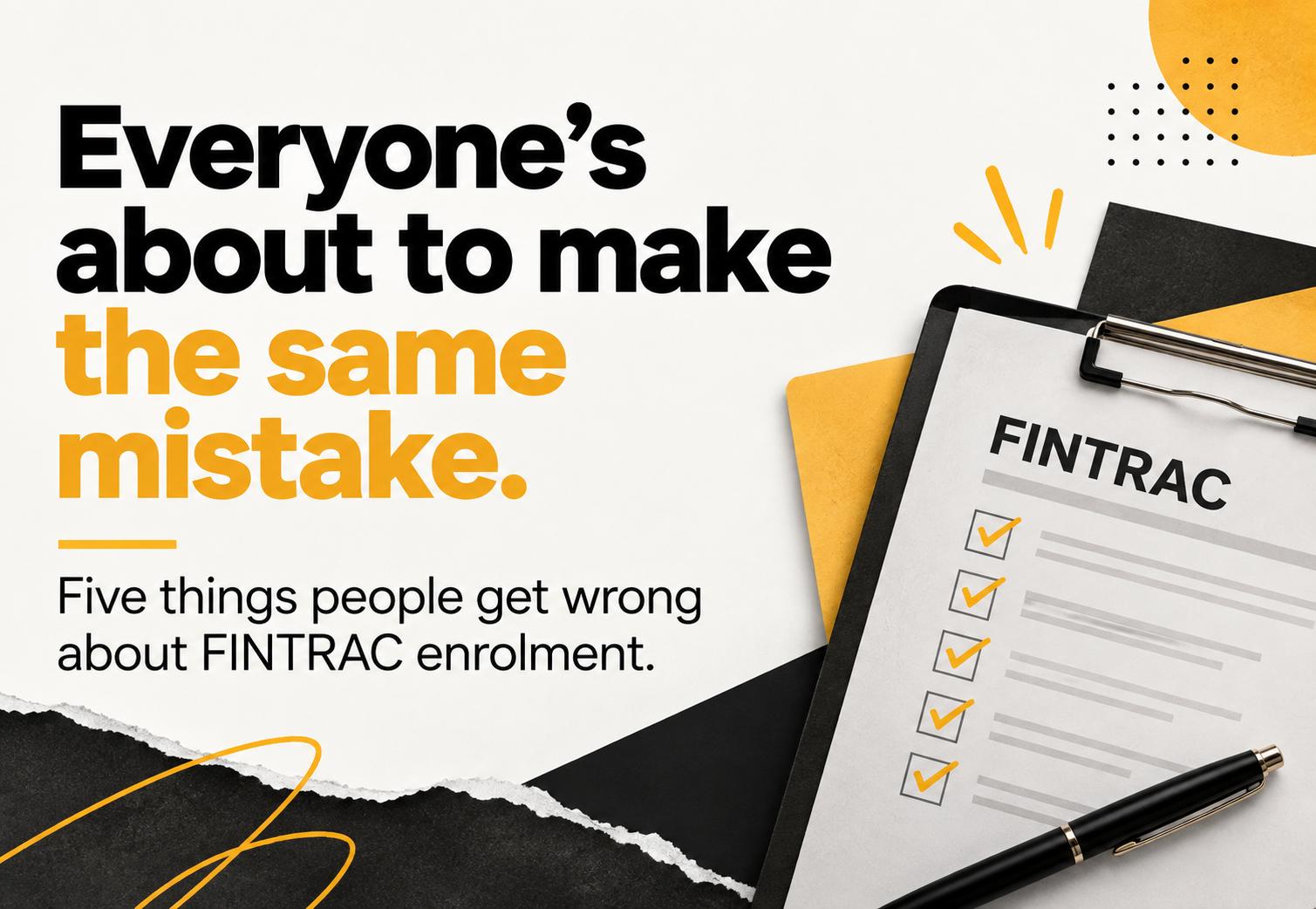
Somebody is going to enroll with FINTRAC this year, breathe a sigh of relief, and be wrong about what just happened.
Universal enrolment under Bill C-12 is coming, part of the same 2026 wave of amendments that raised penalties forty times over, and most of what businesses assume about it isn't quite true. Not because anyone's being careless. Because nobody in these sectors has dealt with FINTRAC before, so there's no instinct yet for what the form actually means.
Here are the five things people keep getting backwards.
What this corrects:five specific misunderstandings about what FINTRAC's universal enrolment actually does and doesn't do.
Who it hits: any business enrolling for the first time, especially sectors new to FINTRAC entirely: accountants, real estate brokers, jewellers, insurers, mortgage brokers.
When it matters: now, while there's still time to fix the assumption before the form is sitting in front of you.
Why now: the first wave of newly regulated businesses is going to fill this out with no FINTRAC experience at all, and a wrong assumption going in is exactly what turns a routine filing into a real gap.
Does FINTRAC Give Your Program a Passing Grade Just for Enrolling?
No. Enrolment is a form.
When you enrol, FINTRAC records who you are, what you do, who owns you, and who your compliance officer is. Nobody at FINTRAC reads your risk assessment before granting the enrolment or checks whether your training actually happened. That review, if it comes, happens later, through an examination or an effectiveness review you're separately required to commission.
Treating "we're enrolled" as proof of compliance is the same mistake as treating a business licence as proof the business is profitable. One confirms you exist. The other confirms you're any good, and DLA Piper's review of the amendments is clear that enrolment is a registration mechanism.
Can You Actually Be Too Small for FINTRAC to Notice?
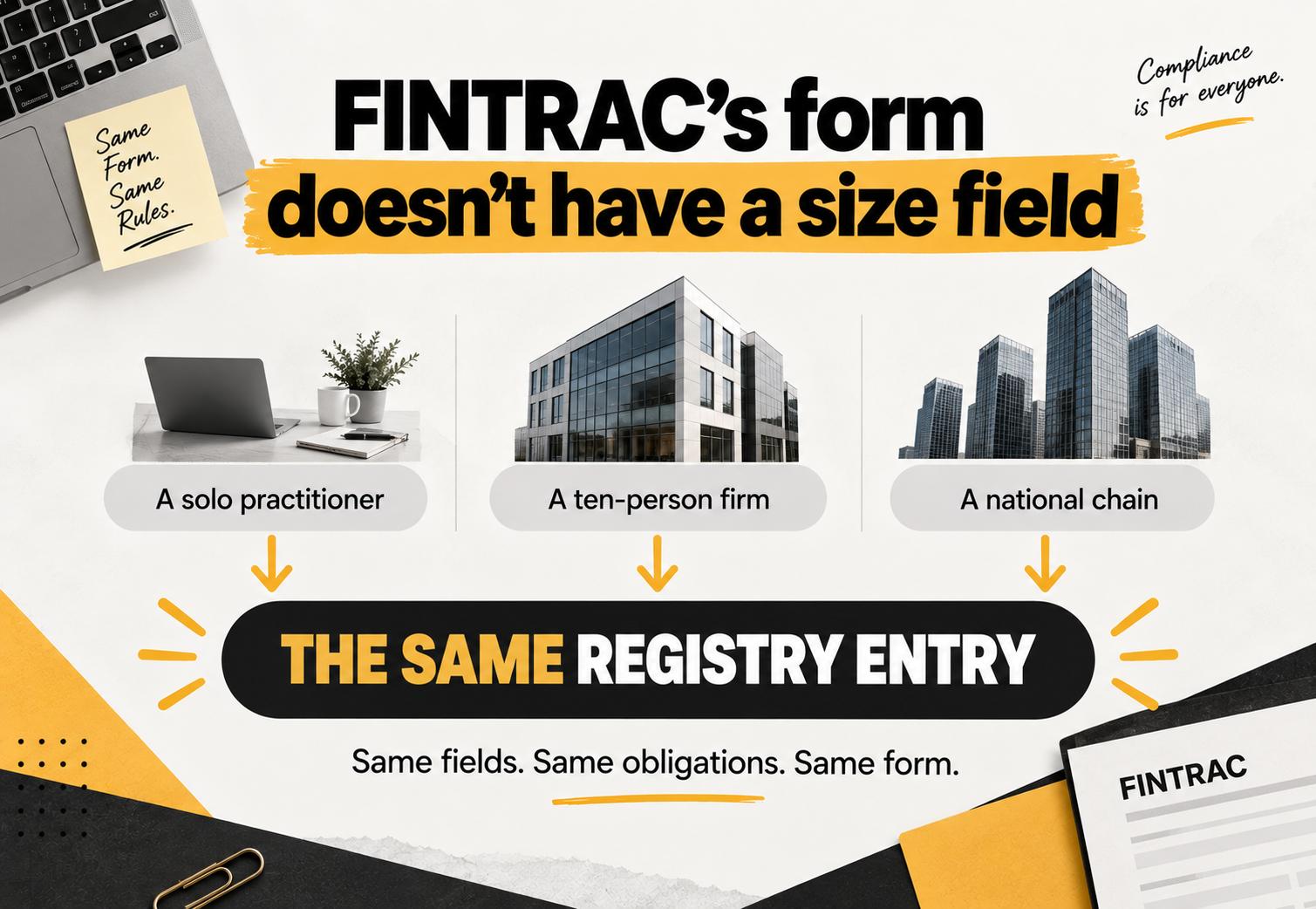
No. There's no size exemption written into who has to enrol.
Section 5 of the PCMLTFA doesn't say "accountants, unless you're a sole practitioner" or "real estate brokers, unless you're independent." If the activity fits the definition, the size of the business doing it doesn't matter.
Title insurers and private ATM acquirers found this out the same way: FINTRAC added them as reporting entities despite being niche, unglamorous corners of the market that assumed nobody was looking. A one-person mortgage brokerage and a national brokerage chain both have to check whether they qualify as a reporting entity, and both get the same answer if they do the same work.
Didn't Your Lawyer Already Take Care of This?
No. Nobody's incorporation paperwork, provincial licensing renewal, or professional association membership enrols you with FINTRAC.
These are separate systems that don't talk to each other. A real estate board renewing your licence has no relationship with FINTRAC's enrolment system, and McCarthy Tétrault's analysis of Bill C-12 is explicit that enrolment sits entirely inside FINTRAC's own process.
Enrolment is a deliberate, additional action, and assuming someone else already checked that box is how a business ends up unenrolled a year after the deadline without ever deciding to be.
Wait, Were You Already Supposed to Be Doing This?
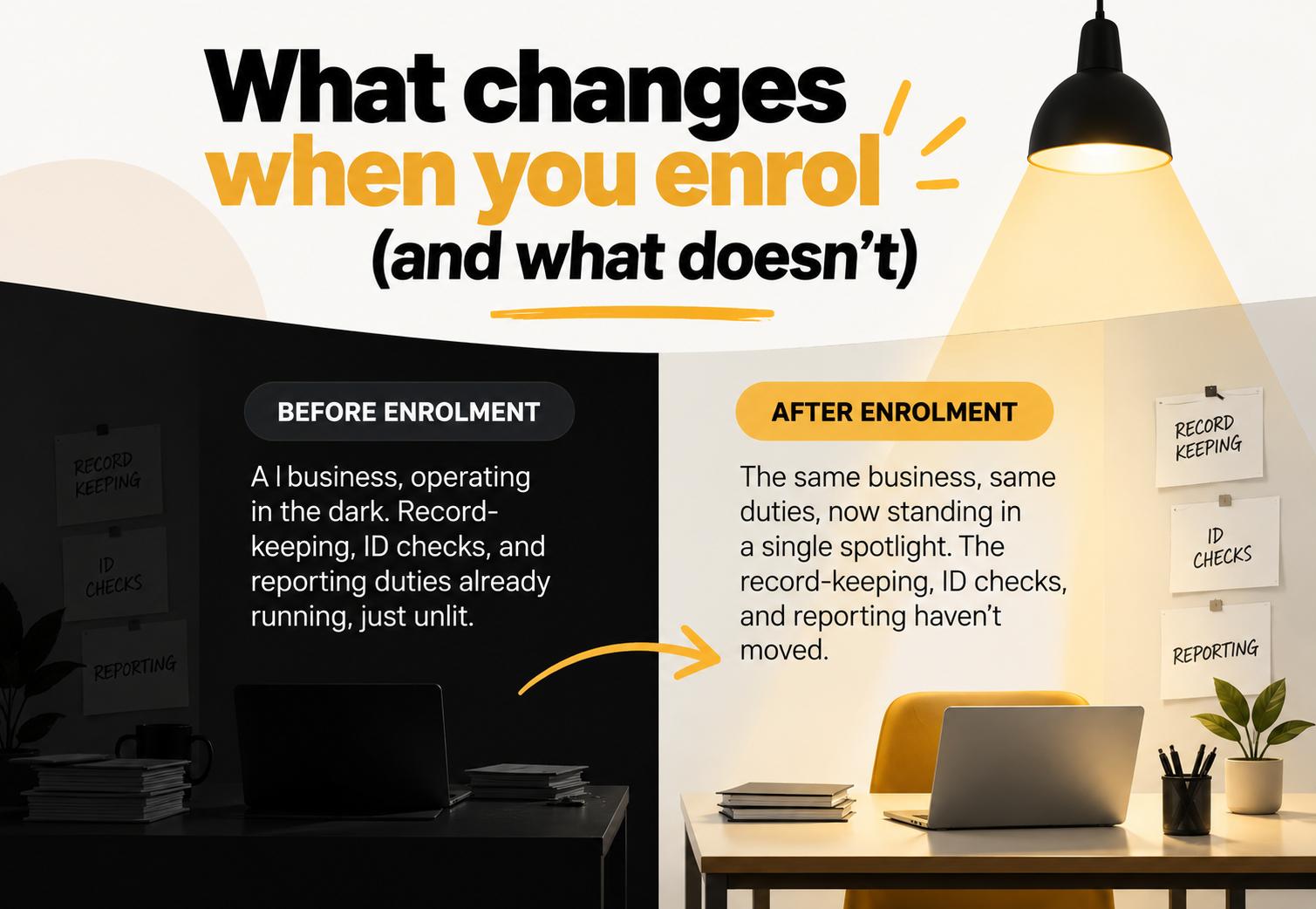
Mostly, yes. For most reporting entities, the underlying duties already exist right now, today, whether or not enrollment has started.
If the Act already applies to your business, you already have to keep records, verify identity, and file reports when something looks wrong, and get your business details right the first time now that discrepancy reporting is mandatory for beneficial ownership mismatches.We covered why that obligation stays the same before and after enrolment in more detail. What enrollment adds isn't a new duty. It's a registry entry that makes an existing duty visible to FINTRAC, and eventually to anyone else who checks the public roll.
That distinction matters because it changes what "getting ready" actually means. You're not building a compliance program from nothing. You're documenting one that, legally, should already exist.
Does Getting Enrolled Make You Bulletproof?
No, and this is the myth with the most expensive consequences if you believe it.
Enrollment doesn't touch your exposure under FINTRAC's penalty framework. If anything, it raises your exposure, because enrollment makes you visible in a way you weren't before. A business with a real compliance program and a business with an empty binder look identical on the public roll.
The difference only shows up when someone actually checks, and enrolment is what puts you in a position to be checked in the first place. Knowing the red flags an examiner actually looks for matters a lot more than the enrolment date on your file.
Enrolment vs. What Everyone Assumes It Means
|
What businesses assume |
What's actually true |
|
FINTRAC reviewed and approved our program |
FINTRAC recorded our details. Nobody reviewed anything. |
|
We're too small for this to apply |
Size isn't a factor in who Section 5 covers. |
|
Our lawyer or accountant already handled it |
Nobody enrols a business but the business itself. |
|
This creates brand-new obligations |
It mostly makes existing obligations visible. |
|
We're protected from penalties now |
Enrolment doesn't touch AMP exposure either way. |
So What Should You Actually Do About It?
-
Write down what enrollment actually is, in one sentence, before you fill anything out. "A registry entry, not a review" is enough to keep the rest of your prep aimed at the right target.
-
Check your size doesn't matter before you check anything else. If your activity is covered, the number of employees you have isn't a defence.
-
Confirm nobody else already did this for you. Ask directly, in writing: has anyone enrolled this business with FINTRAC? If the answer is a shrug, the answer is no.
-
Build the program the enrolment form assumes you already have, starting with naming a compliance officer with real authority.
-
Watch how this went for a country that's already through it. Australia's newly regulated sectors ran this exact experiment months ago, and the mistakes were rarely about the form itself.
-
Treat enrollment as the start of visibility, not the end of the work. The program still has to hold up after you're on the list, not just on the day you joined it.
Picture a Two-Person Accounting Firm in Winnipeg
Two partners, no staff, a handful of small business clients. They assumed, reasonably, that a firm this size wouldn't be on FINTRAC's radar, and that if it somehow was, their CPA body's annual filing would have flagged it by now.
Neither assumption holds up.
Their CPA renewal has nothing to do with FINTRAC. Their size was never the qualifying factor, the services they provide were. When enrolment opens, they'll fill out the same form as a firm fifty times their size, because the Act doesn't ask how many people work there.
The good news for a firm like this is that the actual fix is small. A short, honest risk assessment. A named compliance lead, even if it's one of the two partners. A record of it, dated. None of that requires a big firm's resources. It just requires knowing, ahead of time, that "we're too small" was never going to be the answer.
FAQ
Does enrolling with FINTRAC mean my compliance program is approved?
No. Enrolment records your business details. It doesn't review or approve your program. That happens separately, through examinations and effectiveness reviews.
Is there a size threshold for who has to enroll?
No. Section 5 of the PCMLTFA defines reporting entities by activity, not by size or revenue.
If I'm already licensed provincially, do I still need to enroll with FINTRAC separately?
Yes. Provincial licensing and FINTRAC enrollment are unrelated systems. One doesn't trigger the other.
Does enrollment create new compliance obligations?
Mostly no. If the Act already applies to your business, most of the underlying duties already exist. Enrolment mainly makes your business visible to FINTRAC and, eventually, to the public.
Does being enrolled reduce our risk of penalties?
No. Enrolment has no effect on administrative monetary penalty exposure. It can arguably increase scrutiny, since it makes a business easier to find and check.
We've never dealt with FINTRAC before. Where do we even start?
Start by confirming whether the Act applies to your business at all, then build the basics: a named compliance officer, a written risk assessment, and a record of both.
When does enrollment actually open?
Still not set. FINTRAC's own upcoming changes page still describes it in the future tense, and BLG's client update on universal enrolment confirms the substantive regulations still hadn't appeared in the Canada Gazette, Part II as of this writing.
Get In Touch
Enrolling is the easy part once your program actually exists. The myths above are usually what's standing between a business and that program, not the form itself.
FINTRAC MSB Registration: enrolment readiness for businesses that have never registered with FINTRAC before, handled end to end.
AML Effectiveness Review: an independent review of whether your program would actually hold up, not just whether it exists on paper.
CAMLO and MLRO Services: a qualified compliance officer with real authority, the person enrolment expects you to be able to name.
Book a discovery call and we'll walk through where your program actually stands.