Your NFT Marketplace Might Already Be a Money Services Business
A 2026 study found wash trading showing up in nearly four out of every ten NFT trades. Most of it happens in plain sight, dressed up as an ordinary sale between two people who, it turns out, are the same person. Here's how the mechanism actually works, and why Canadian platforms might already be closer to FINTRAC's radar than they think.
Somebody buys their own NFT.
They control both wallets, and they know exactly what they're doing.
That's NFT wash trading, and it isn't a rounding error in the market. A study published this year found the pattern showing up in roughly four out of every ten NFT trades across several major marketplaces.
Almost no Canadian compliance program has a policy that mentions it.
What changed: wash trading turns out to touch a much bigger share of the NFT market than most people assumed, and it can move real value while looking like ordinary trading.
Who it hits: any Canadian business that lets customers buy, sell, or trade NFTs using cryptocurrency, not just the platforms that call themselves exchanges.
Why now: researchers just measured the scale for the first time this year, and most compliance programs still treat NFTs as a niche nobody needs a written position on.
What Does NFT Wash Trading Actually Look Like?
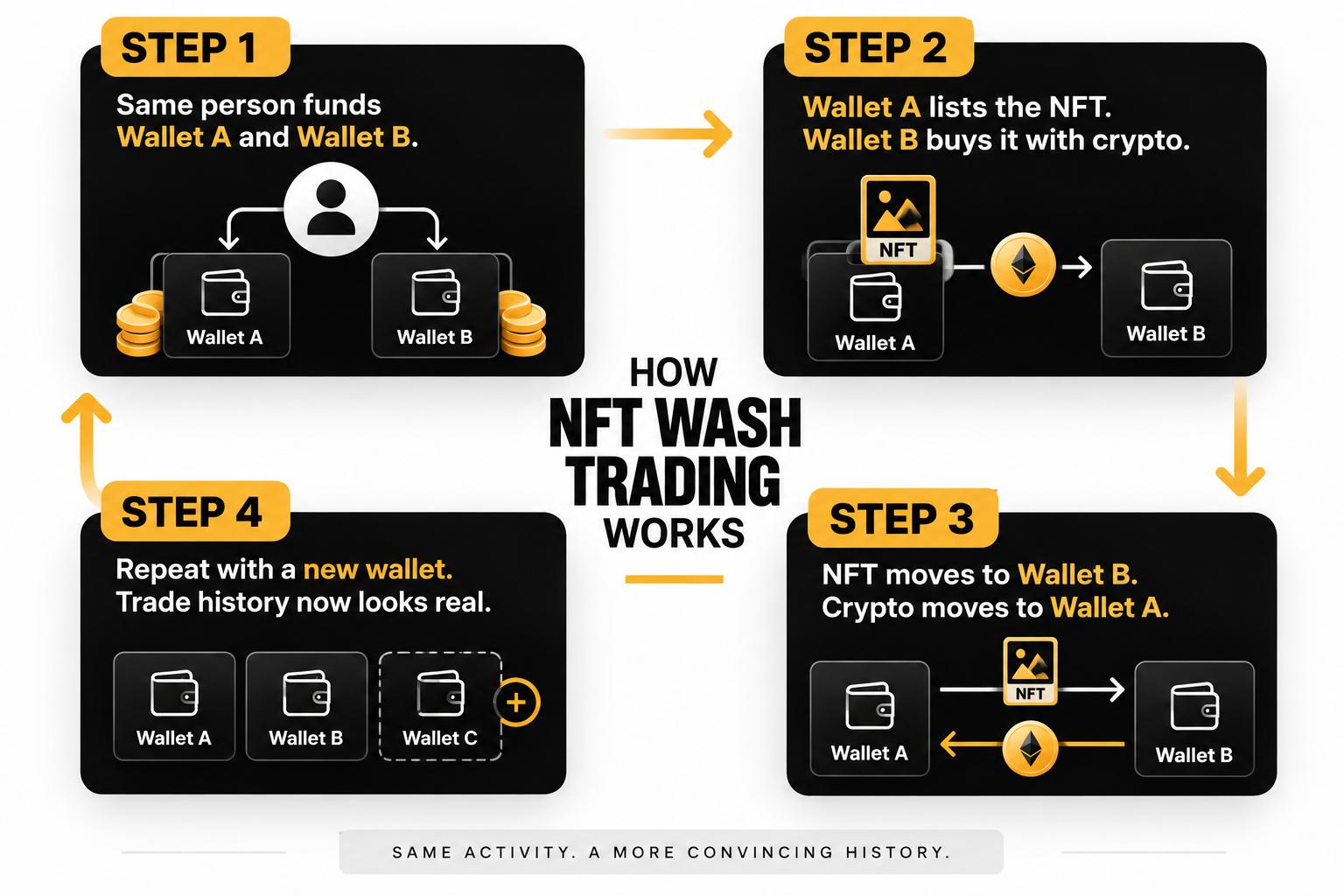
It looks like a healthy market, right up until someone checks who's on both sides of the trade.
Chainalysis first documented this at scale in its 2022 Crypto Crime Report. They found 262 users who had sold an NFT to a wallet they'd personally funded more than twenty-five times each. A subset of 110 of those addresses had collectively pulled in close to $8.9 million in profit doing it. One trader, the most prolific one Chainalysis found, had made 830 sales to wallets they'd financed themselves.
That was three years ago, and the practice still continued.
A study published in 2026 measured wash trading patterns across several major NFT marketplaces and found the footprint covering roughly 38% of trades and 60% of traded value.
It means the dollars moving through wash trades outweigh the share of trades that are wash trades, which tells you the people doing this are running it as a program.
Why Does Selling Yourself a JPEG Count as Money Laundering?
Because the goal was never really the JPEG.
Money laundering runs through three stages: getting dirty money into the system, moving it around to obscure where it came from, and then pulling it back out looking clean.
Wash trading is a layering technique that happens to run on art instead of shell companies.
Someone funds two wallets. Wallet A sells an NFT to Wallet B for a large amount of cryptocurrency. On paper, that's a sale with a buyer and a seller. In reality, it's the same person moving value from one pocket to another, except now that value has a transaction history, a marketplace receipt, and the appearance of a legitimate capital gain.
Run that same loop through a marketplace with instant payouts to a bank-linked exchange account, and the crypto that started the loop can come out the other end looking like proceeds from art sales. It's the same mechanism Chainalysis flagged when it first went looking for it.
Does FATF Even Count NFTs as a Virtual Asset?
Usually not, which is precisely the blind spot this whole problem lives in.
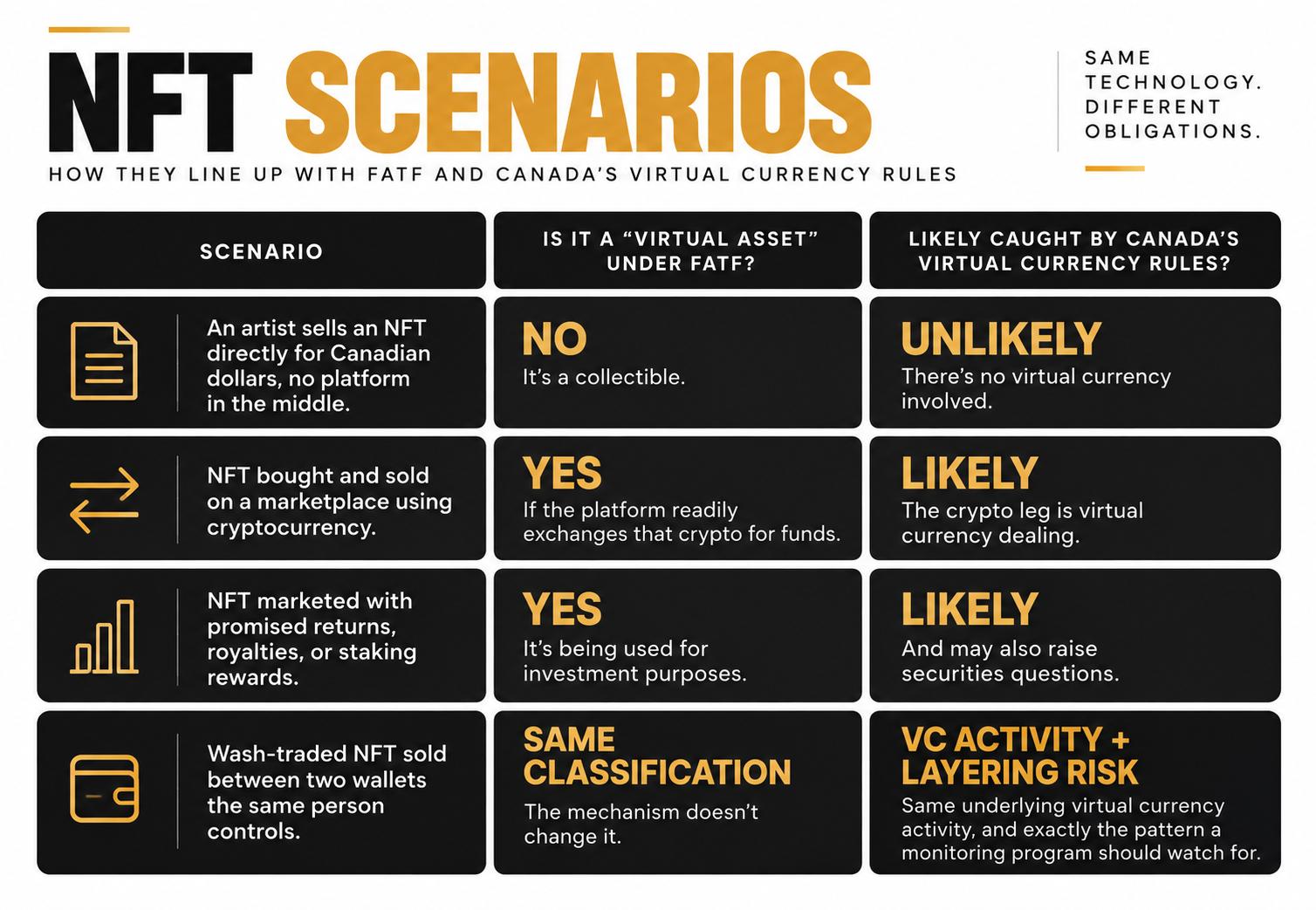
FATF's official position treats NFTs as collectibles, not virtual assets, when they're genuinely unique items being traded for their own sake. But FATF also says that the same NFT becomes a virtual asset the moment it's used for payment, investment, or to transfer value, and it tells regulators to evaluate this case by case rather than drawing one clean line.
That single carve-out is why an NFT platform can look completely outside AML rules and still not be. A one-of-one digital painting sold to a genuine collector is one thing. The same painting sold, resold, and resold again between wallets the seller controls, with proceeds routed through cryptocurrency, is functionally an investment vehicle, whatever the listing page calls it.
So Is Your NFT Platform a Reporting Entity in Canada?
Possibly, and FINTRAC has never spelled it out by name.
There is no FINTRAC guidance that mentions NFTs directly. Search for it and you'll find plenty on virtual currency exchanges and nothing written for platforms trading unique digital collectibles. That's not the same as an exemption.
FINTRAC defines virtual currency as a digital representation of value used for payment or investment purposes that can be readily exchanged for funds or for another virtual currency. A business dealing in that virtual currency, meaning exchanging it or transferring it as part of its operations, has had to register as a money services business since June 1, 2020, the same rule that now separates MSBs from VASPs and PSPs depending on what a platform actually does.
An NFT marketplace itself isn't automatically caught. But the moment it facilitates the cryptocurrency leg of an NFT sale, converts proceeds for a user, or lets value move in and out of the platform through virtual currency, it starts to look a lot likethe kind of business that has to ask whether it qualifies as an MSB in the first place.
Which NFT Transactions Might Actually Fall Under FINTRAC's Scope?
What Has Actually Been Prosecuted So Far?
Not much in Canada specifically.
The closest thing to a criminal NFT case, the OpenSea insider-trading prosecution against a former employee, didn't even survive on appeal. Prosecutors dropped it in 2025 after a court ruled the confidential listing data at the center of the case wasn't 'property' under federal wire fraud law.
The clearest enforcement action to date is American. In August 2023, the SEC charged Impact Theory with running an unregistered securities offering through its NFT sales, and the company paid more than $6.1 million in disgorgement, interest, and penalties after raising roughly $30 million from investors. That case was about marketing NFTs as investments, which is exactly the trigger FATF's guidance points to.
On the wash trading side specifically, US prosecutors charged eighteen individuals and entities in October 2024 for manipulating digital asset markets through wash trading, including several crypto market makers. Again, not NFT-specific, but it shows regulators are treating wash trading itself as prosecutable fraud.
No FINTRAC enforcement action naming NFT wash trading has been made public as of this writing. That's not proof of safety. It's usually just a sign the first case hasn't landed yet.
What Should a Canadian MSB or NFT Platform Do This Quarter?
-
Find out if NFT-for-crypto activity is actually happening on your platform. If customers can pay for or cash out NFTs in cryptocurrency, that's a virtual currency transaction wearing a different outfit.
-
Decide, in writing, whether that makes you a virtual currency dealer. Silence isn't a position. A dated, one-page answer is, even if the answer is "not yet, here's why."
-
Build a wash-trading heuristic into your monitoring, not just a fraud filter. Chainalysis's own method was simple: flag wallets that repeatedly sell to addresses they've personally funded. You don't need a research team to replicate the basic version of that.
-
Read your existing transaction monitoring rules against this specific pattern. Most were built for payment velocity, not for a buyer and seller who are secretly the same wallet cluster.
-
Know what happens if you guessed wrong. Operating as an unregistered virtual currency dealer carries the same exposure as any other unregistered MSB, and that exposure isn't limited to platforms that call themselves crypto exchanges.
Picture a Marketplace Based in Halifax
They built the platform to sell generative art, or so the product description says.
Eighteen months in, a feature they added to make checkout easier lets users pay in ETH and cash out proceeds to an exchange account with one click. Usage climbed. So did something else: a small cluster of wallets that keep buying from each other, always slightly below the platform's manual-review threshold, always cashing straight out afterward.
It became a compliance failure gradually, the same way most of them do, through a product decision nobody flagged as a virtual currency question.
FAQ
What is NFT wash trading?
Selling an NFT to a wallet you also control, so it looks like a genuine sale between two different people when it isn't.
Is NFT wash trading illegal in Canada?
There's no law that names it specifically, but the underlying conduct, using layered transactions to disguise the source or ownership of funds, falls under Canada's existing money laundering rules regardless of what asset carries it.
Does FATF consider NFTs virtual assets?
Generally no, when they're traded purely as collectibles. Yes, when they're used for payment, investment, or to transfer value, which FATF says has to be assessed case by case.
Does FINTRAC regulate NFT platforms?
There's no FINTRAC guidance that mentions NFTs directly. A platform can still be caught if it deals in the virtual currency used to buy or cash out NFTs, which is a registration requirement that's existed since June 2020.
How common is NFT wash trading, really?
A 2026 study found the pattern across roughly 38% of trades and 60% of traded value on several major marketplaces. Chainalysis's earlier research put self-financed wash trading profits in the millions of dollars.
Has anyone actually been prosecuted for this?
Not specifically for NFT wash trading in Canada, as of this writing. The SEC has prosecuted NFT sales as unregistered securities in the US, and US prosecutors have separately charged wash trading in digital assets as market manipulation.
What should we do if we're not sure whether we qualify as a virtual currency dealer?
Write down your answer and your reasoning now, with a date on it. An examiner treats a documented, wrong-but-reasonable position very differently from silence.
Get In Touch
If your platform touches NFTs, cryptocurrency, or both, and nobody has put in writing whether that makes you a virtual currency dealer, that's worth resolving before an examiner asks the question for you.
AML Effectiveness Review: an independent review of your program, including channels like NFT and crypto activity that may not be named anywhere in your current risk assessment.
CAMLO and MLRO Services: a qualified compliance officer who can actually make the registration call and defend it.
FINTRAC MSB Registration: for platforms that need to register as a virtual currency dealer, or need help deciding whether they have to.
Book a discovery call and we'll walk through where your platform actually stands.