What Is a Money Mule? Meaning, Warning Signs and Real Examples (2026)
A money mule moves stolen money through their own bank account for someone else. Here's what it means, how people get pulled in, and the signs to watch for.
A money mule is someone who receives money from one person and passes it on to another, on behalf of someone else, when that money came from crime.
Criminals use mules to hide where stolen money came from. Many mules don't know they're doing anything wrong. They think they've found an easy job, are helping a friend, or are doing a favour for someone they met online.
The FBI describes a money mule as someone who moves illegally obtained money for another person. Moving that money is part of money laundering, even if the mule never meets the criminal.
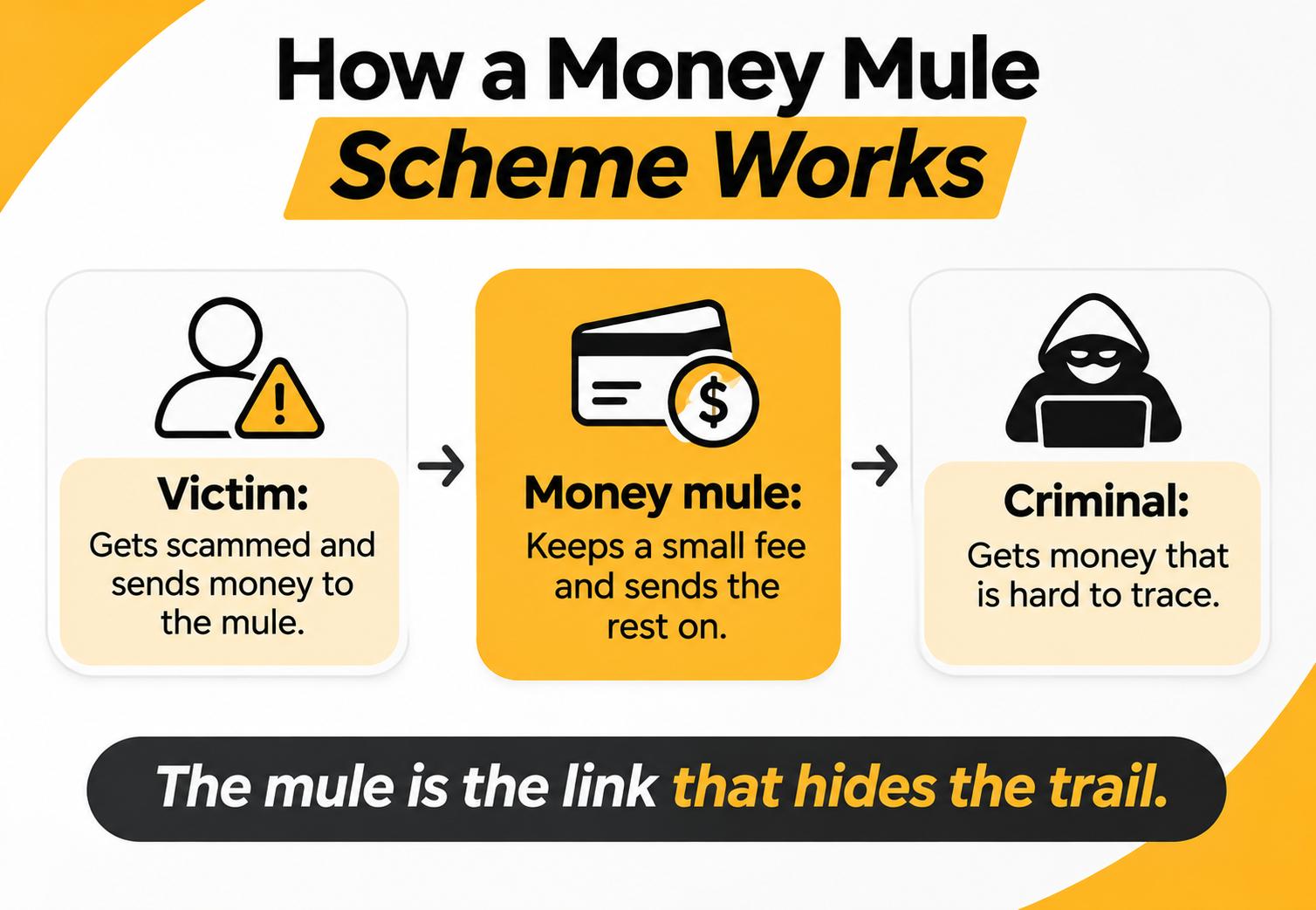
Think of a mule carrying a load for someone else. A money mule carries money:
- Money comes in: Stolen money, for example from a scam victim, lands in the mule's bank account.
- The mule moves it: They send it on by bank transfer, gift cards, crypto or cash, often keeping a small "fee".
- The trail goes cold: The money ends up with the criminal, and the victim's money now looks like it came from an ordinary person's account.
This is the layering stage of money laundering: moving money around to hide where it came from.
See the 3 stages of money laundering.
The 3 types of money mules
| Type | What they know |
|---|---|
| Unwitting | Doesn't know the money is from crime. Often tricked by a fake job or romance scam. |
| Witting | Ignores the warning signs, or keeps going after being warned by their bank or the police. |
| Complicit | Knows exactly what they're doing, and may recruit other mules. |
How people become money mules
Criminals rarely say "launder money for us". They use a story:
- Fake jobs: "Payment processing agent", "financial assistant" or "work from home, earn $500 a week". The job is to receive payments and forward them.
- Romance scams: an online partner asks you to receive money and send it on, or to open an account for them.
- "Sell" your account: students and young people are offered cash to hand over their bank card and login.
- Prizes and loans: "You've won", or "we'll lend you money for a crypto investment", but first you must move some funds.
- Package reshipping: receiving goods bought with stolen cards and posting them on.
Money mule warning signs (red flags)
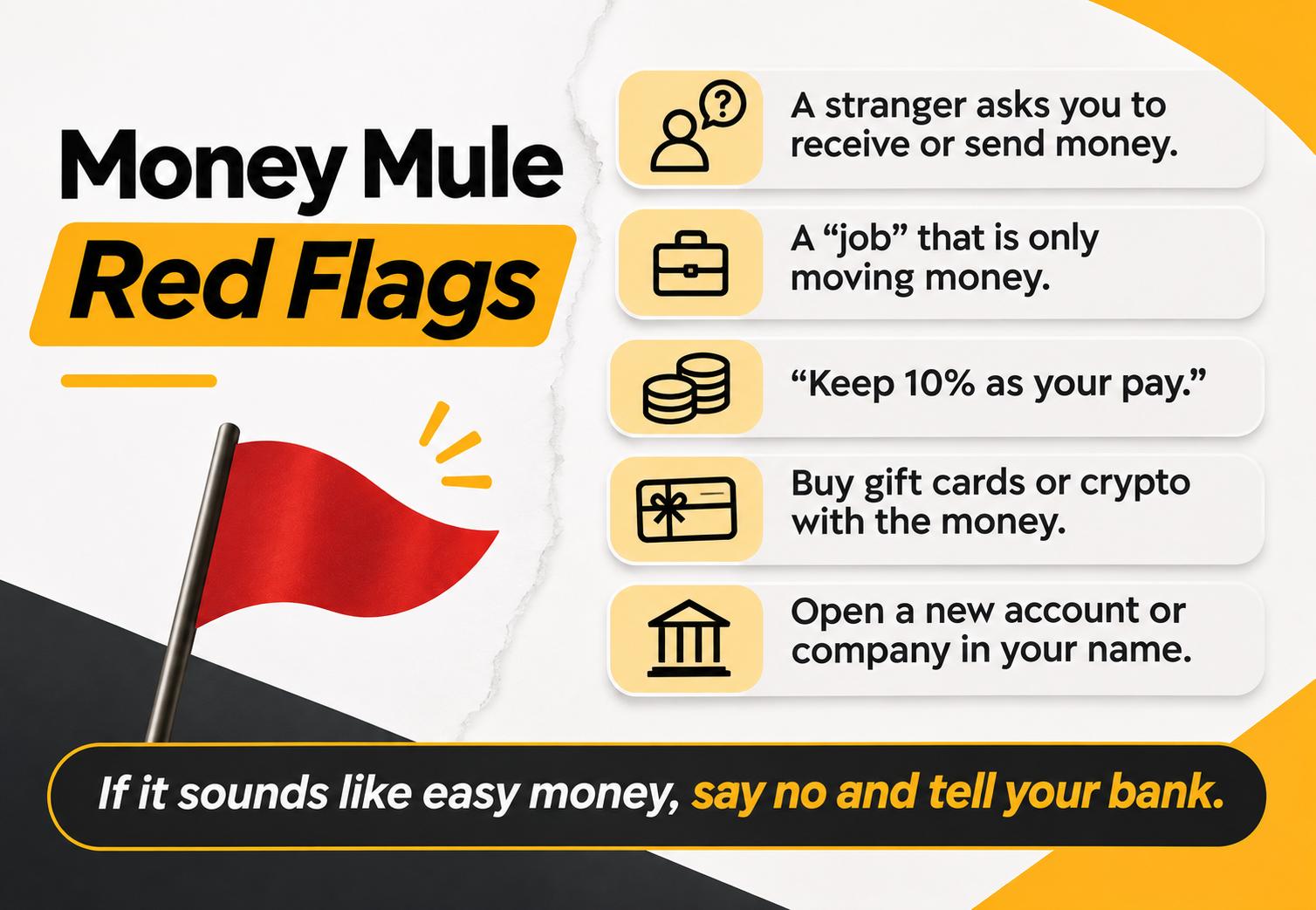
For individuals:
- Someone you've never met in person asks you to receive or send money for them
- A job that only involves moving money through your own account
- You're asked to keep part of the money as payment
- You're told to buy gift cards or crypto with the money
- You're asked to open a new bank account or company in your name
For banks, fintechs and money services businesses:
- Money comes in from many unrelated people and goes out within hours
- A new account that suddenly gets large incoming transfers
- Incoming payments followed by crypto purchases, gift cards or cash withdrawals
- Activity that doesn't match the customer's age, job or expected use
- Many accounts sharing the same device, phone number or address
For more patterns, see the top 10 AML red flags.
Real money mule examples
1. The fake job:
A college student answers an online ad for a "payment processing assistant". Payments arrive in their account, and they send 90% on by wire. The money came from people tricked by online scams. The student's account is closed, and the bank flags them.
2. The online partner:
A retiree meets someone on a dating app. After months of messages, the partner asks them to receive "business payments" and forward them overseas. The payments are money stolen from other romance scam victims.
3. The "sold" bank account:
A young person is offered $500 to hand over their debit card and banking login. Criminals then use the account to move stolen money. Because it's in their name, the activity is linked to them.
4. The US crackdown:
The US Department of Justice runs a yearly Money Mule Initiative. In 2021, authorities took action against about 4,750 money mules. In 2024, they took action against more than 3,000. Most received warning letters, and some were prosecuted.
5. Canada:
In 2024, the RCMP and the BC Securities Commission hand-delivered warning letters to suspected money mules in Metro Vancouver who were moving money for overseas investment fraud. The Canadian Anti-Fraud Centre regularly warns that students, seniors and newcomers are common targets.
More real cases in 12 money laundering examples.
Is being a money mule illegal?
Yes.
Moving money from crime can count as money laundering, even if you kept only a small fee. In the US and Canada, mules can face criminal charges, and saying you "didn't know" isn't always accepted, especially after a warning. Mules can also have their bank accounts closed, find it hard to open new ones, and be asked to repay the money.
What to do if you think you're being used as a money mule
- Stop moving money right away.
- Tell your bank and keep all messages and records.
- Report it. In the US, report to the FBI's Internet Crime Complaint Center (ic3.gov). In Canada, report to the Canadian Anti-Fraud Centre (antifraudcentre.ca) and your local police.
How businesses stop money mules
Banks, fintechs, payment companies and crypto exchanges are the first line of defence. A strong AML program spots mules early:
- KYC at sign-up: check who the customer is and what they'll use the account for.
See what is KYC. - Transaction monitoring: set alerts for fast in-and-out money and many unrelated senders.
- Device and behaviour checks: spot many accounts on one device or address.
- Reporting: file suspicious activity reports with FinCEN (US) or suspicious transaction reports with FINTRAC (Canada).
- Training: teach staff the warning signs.
AML Incubator helps MSBs, fintechs and crypto companies in Canada and the US build AML programs that catch mule activity, and provides outsourced compliance officers. Check any MSB on our free MSB registry search, or talk to us.
FAQs
What is a money mule?
Someone who moves money from crime for another person, usually through their own bank account. Criminals use mules to hide where stolen money came from.
What is a mule account?
A bank or payment account used to receive and pass on money from crime. It can belong to a real person who was recruited or tricked, or be opened with stolen or fake details.
Can you be a money mule without knowing?
Yes. Many mules are tricked by fake jobs, romance scams or "easy money" offers. But once there are warning signs, continuing to move money can still lead to charges.
Why do criminals use money mules?
To hide the trail. Money that passes through an ordinary person's account is harder to trace back to the crime.
How do banks find money mules?
By monitoring accounts for patterns like money coming in from many people and leaving quickly, new accounts with sudden large transfers, and many accounts linked to one device.
What should I do if someone asks me to move money?
Say no, don't share your bank details, and report it to your bank and to the FBI (ic3.gov) or the Canadian Anti-Fraud Centre.