What Is KYC? Know Your Customer Meaning, Process and Examples (2026)
KYC, or Know Your Customer, is how banks, fintechs and crypto platforms confirm who they're dealing with. Here's what it means, how it works, and real examples.
KYC stands for Know Your Customer. It's the process banks, fintechs, crypto exchanges and other financial businesses use to confirm who their customers are, understand what they'll use the account for, and spot anything suspicious.
KYC is a core part of anti-money laundering (AML) rules in the US, Canada and most of the world.
When an app asks for your ID and a selfie before you can send money, that's KYC.
KYC meaning in plain English
KYC is a business asking three simple questions:
- Who are you? Name, date of birth, address and an ID.
- What will you do with this account? Your job, where your money comes from, and how you plan to use the service.
- Does anything look off? Is the customer on a sanctions list, a politically exposed person (PEP), or acting in a way that doesn't fit?
The goal is simple: stop criminals from using the business to launder money, fund terrorism or commit fraud.
Who has to do KYC?
Any business covered by AML laws, including:
- banks and credit unions
- money services businesses (MSBs) and payment companies
- crypto exchanges and crypto ATMs
- fintech apps and neobanks
- securities dealers and brokers
- casinos
- real estate and some other businesses that handle large payments
The KYC process, step by step
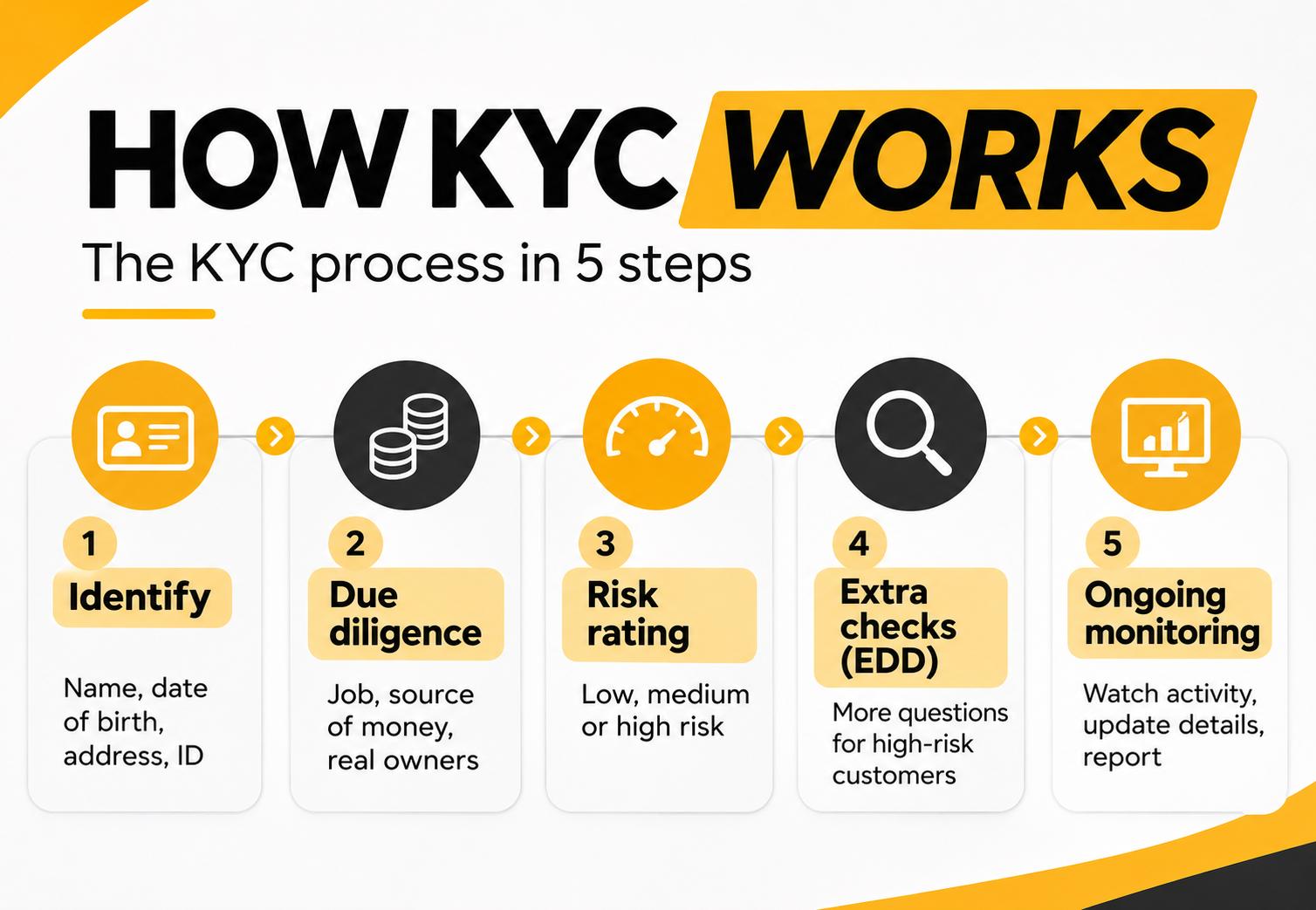
Step 1: Customer identification.
Collect and verify basic details. In the US, banks must collect at least a name, date of birth, address and an ID number (the Customer Identification Program, or CIP). In Canada, FINTRAC lets businesses verify identity with methods such as government-issued photo ID, a credit file, or the dual-process method.
Step 2: Customer due diligence (CDD).
Understand the customer: their job or business, the source of their money, and the expected activity. For companies, find the beneficial owners, the real people behind the business. In both the US and Canada, that generally means anyone owning 25% or more.
Step 3: Risk rating.
Rate each customer low, medium or high risk, based on things like country, product, transaction size and business type.
Step 4: Enhanced due diligence (EDD).
Ask more questions of high-risk customers: source of wealth, more documents, senior approval.
Step 5: Ongoing monitoring.
KYC doesn't end at sign-up. Watch transactions, update customer details, and report suspicious activity.
What is KYC verification?
KYC verification is the identity check part of KYC: confirming a customer is who they say they are.
Today it's usually done online (eKYC):
- ID document check: a photo of a passport or driver's licence
- Selfie or liveness check: proves the person holding the ID is real and present
- Database checks: credit bureau or government data
- Sanctions and PEP screening: checking names against watchlists
KYC in banking
Banks were the first to use KYC, and their rules are the strictest. When you open a bank account, the bank verifies your ID, asks about your job and expected deposits, and screens you against sanctions lists. Large cash deposits, unusual transfers or a business account with unclear owners can trigger extra checks.
KYC in crypto
Crypto exchanges registered as MSBs in the US (with FinCEN) and Canada (with FINTRAC) must do KYC just like banks. That usually means an ID check and a selfie before you can trade or withdraw. Crypto adds extra steps, such as the travel rule (sending customer information with transfers) and checking where coins came from.
Read more in KYC in crypto: what it is and why it matters.
KYC examples
| Situation | What KYC looks like |
|---|---|
| Opening a bank account | ID, address, job and expected deposits |
| Signing up for a crypto app | Photo of your ID, plus a selfie video |
| A company opening a business account | Company documents, plus the names of everyone owning 25% or more |
| A high-risk customer | Extra questions about where their money comes from, and senior sign-off |
| A customer's activity changes | The business reviews the account and asks for updated information |
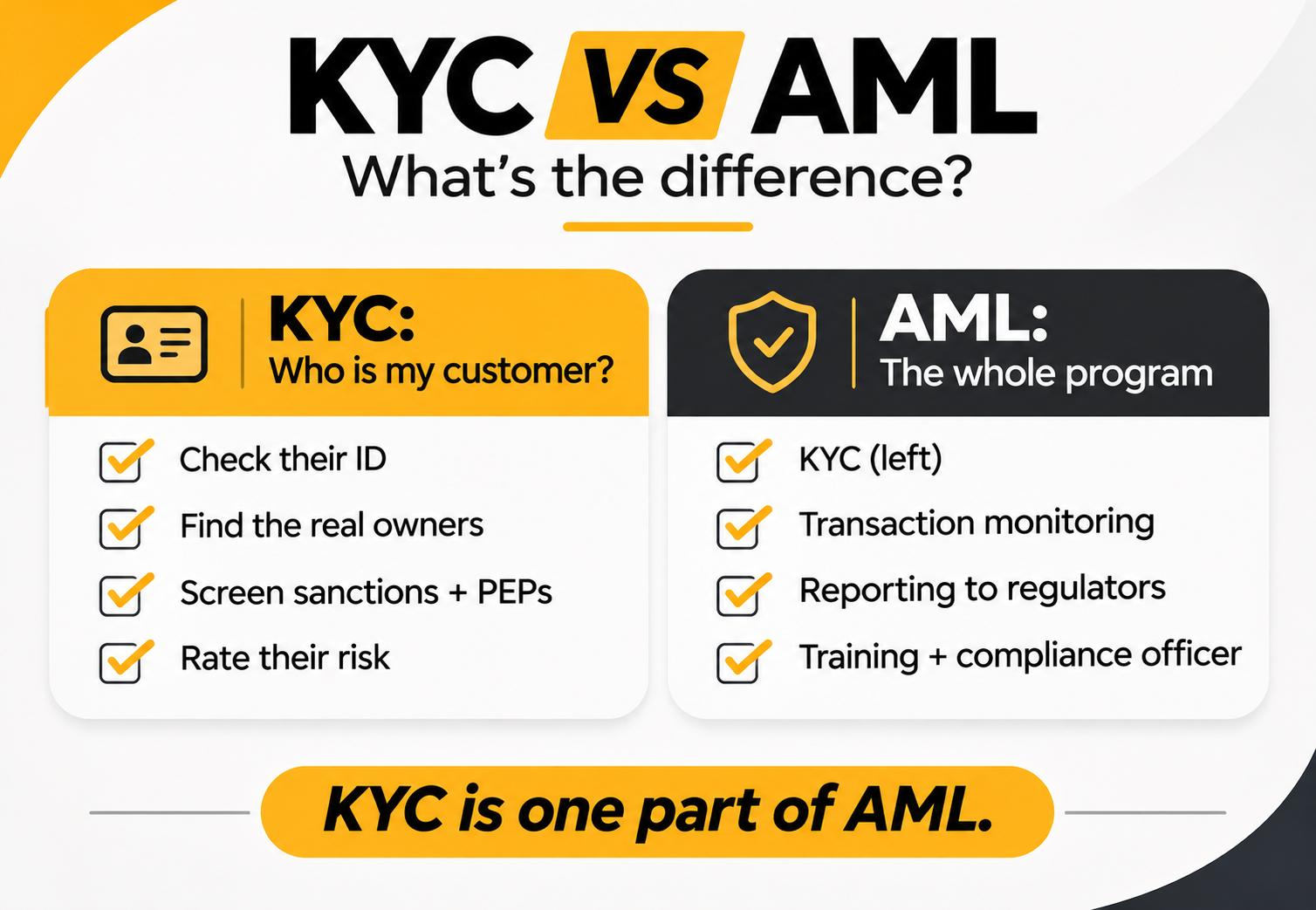
KYC vs AML: what's the difference?
- AML (anti-money laundering) is the whole program: policies, a compliance officer, training, monitoring and reporting.
- KYC is one part of it: knowing who your customers are.
KYC is how you know who you're dealing with. AML is everything you do with that knowledge.
See how KYC and AML programs work together.
What happens when KYC fails?
Weak KYC is one of the most common reasons for big AML penalties:
- Binance agreed to pay about $4.3 billion in 2023, in part for failing to properly verify users.
- TD Bank agreed to pay about $3 billion in 2024 after failing to monitor transactions.
See more in 12 real money laundering cases.
Common KYC mistakes
- Collecting IDs but never reviewing them again
- Not identifying beneficial owners of business customers
- Treating every customer the same instead of rating risk
- Skipping sanctions and PEP screening on existing customers
- Weak records that can't show a regulator what was checked
Need help with KYC?
AML Incubator builds KYC and AML programs for MSBs, fintechs and crypto companies in Canada and the US, and provides outsourced compliance officers. Check any MSB on our free MSB registry search, or talk to us.
FAQs
What does KYC stand for?
Know Your Customer. It's the process financial businesses use to verify who their customers are.
What is KYC verification?
The identity check part of KYC: confirming a customer's identity with an ID document, a selfie or liveness check, and database checks.
Why is KYC required?
AML laws require it to stop criminals from using financial services to launder money, fund terrorism or commit fraud.
Is KYC the same as AML?
No. KYC is one part of an AML program. AML also includes monitoring, reporting, training and a compliance officer.
How long does KYC take?
Online KYC can take minutes. Business or high-risk customers can take days, because more documents are needed.
What documents are needed for KYC?
Usually a government-issued photo ID and proof of address. Businesses also provide company documents and details of their owners.