RPAA Registration: How to Apply to the Bank of Canada, Step by Step (2026)
Who must register under the RPAA, how to apply through PSP Connect, the fee, what the Bank of Canada asks for, timelines, and what you must do after registration.
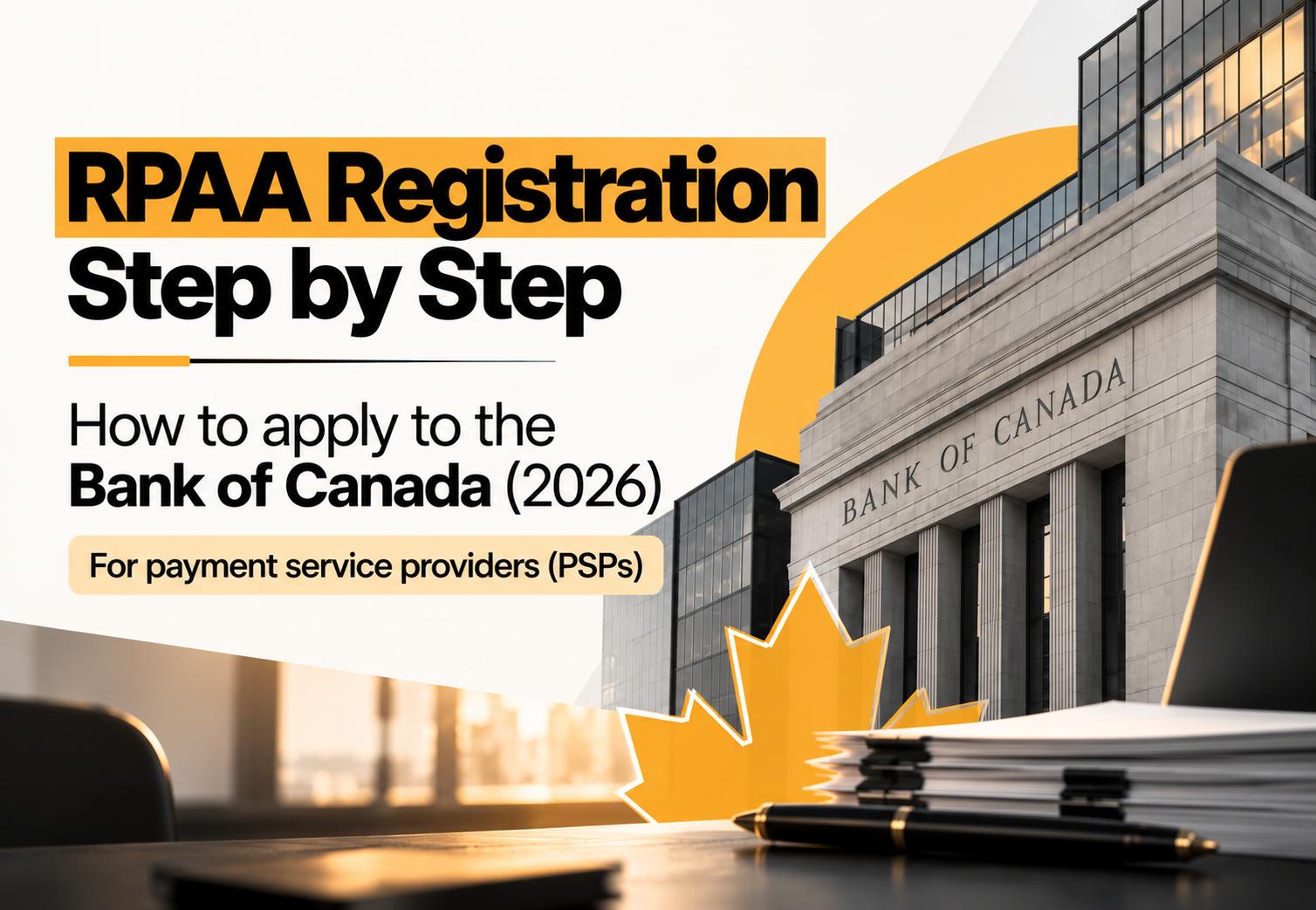
If your business performs payment functions for people or businesses in Canada, you must register with the Bank of Canada under the Retail Payment Activities Act (RPAA). Since September 8, 2025, you must be registered before you start.
You apply online through the Bank's PSP Connect portal and pay a one-time, non-refundable fee of about $2,500. Then you answer the Bank's questions while it reviews your application, including a national security review.
Once approved, you appear on the Bank's public registry and must file an annual report every year.
What is RPAA registration?
The Retail Payment Activities Act is Canada's law for payment service providers (PSPs).
Think of payment apps, payment processors, digital wallets and money transfer platforms. The Bank of Canada supervises these businesses. It checks that they protect customers' money (safeguarding) and manage operational risks such as outages and cyber incidents.
Registration is the first step. It tells the Bank who you are, what you do and how you manage risk. You can't legally offer in-scope payment services in Canada without it.
The RPAA is separate from FINTRAC. Many PSPs are also money services businesses (MSBs) and need FINTRAC MSB registration as well. Not sure which applies to you? See MSB vs VASP vs PSP.
Do you need to register? The 4 tests
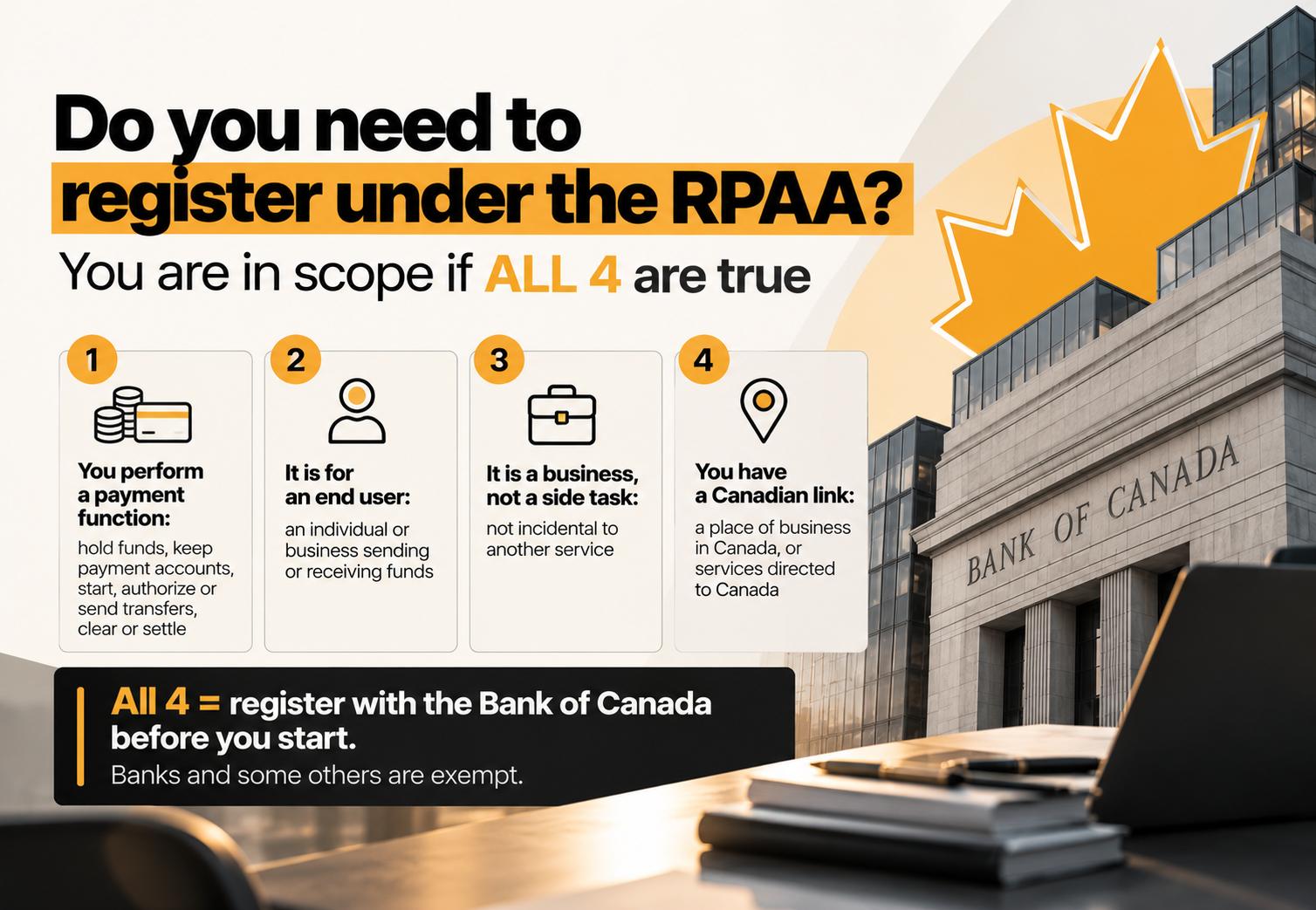
You are in scope if all 4 of these are true:
- You perform a payment function.
The RPAA lists 5:- keeping payment accounts for users
- holding funds for users
- starting a transfer at a user's request
- authorizing or sending transfers
- clearing or settling payments
- You do it for an end user, meaning an individual or business that sends or receives the money.
- It's a service in its own right, not just incidental to another service you provide.
- You have a link to Canada:
a place of business in Canada, or you direct your services to people in Canada (even from abroad).
Some businesses are excluded.
Banks, credit unions and other already-regulated financial institutions are among them, and some kinds of transfers are excluded too.
If you're unsure, get the scoping done properly first. Getting it wrong either way is costly.
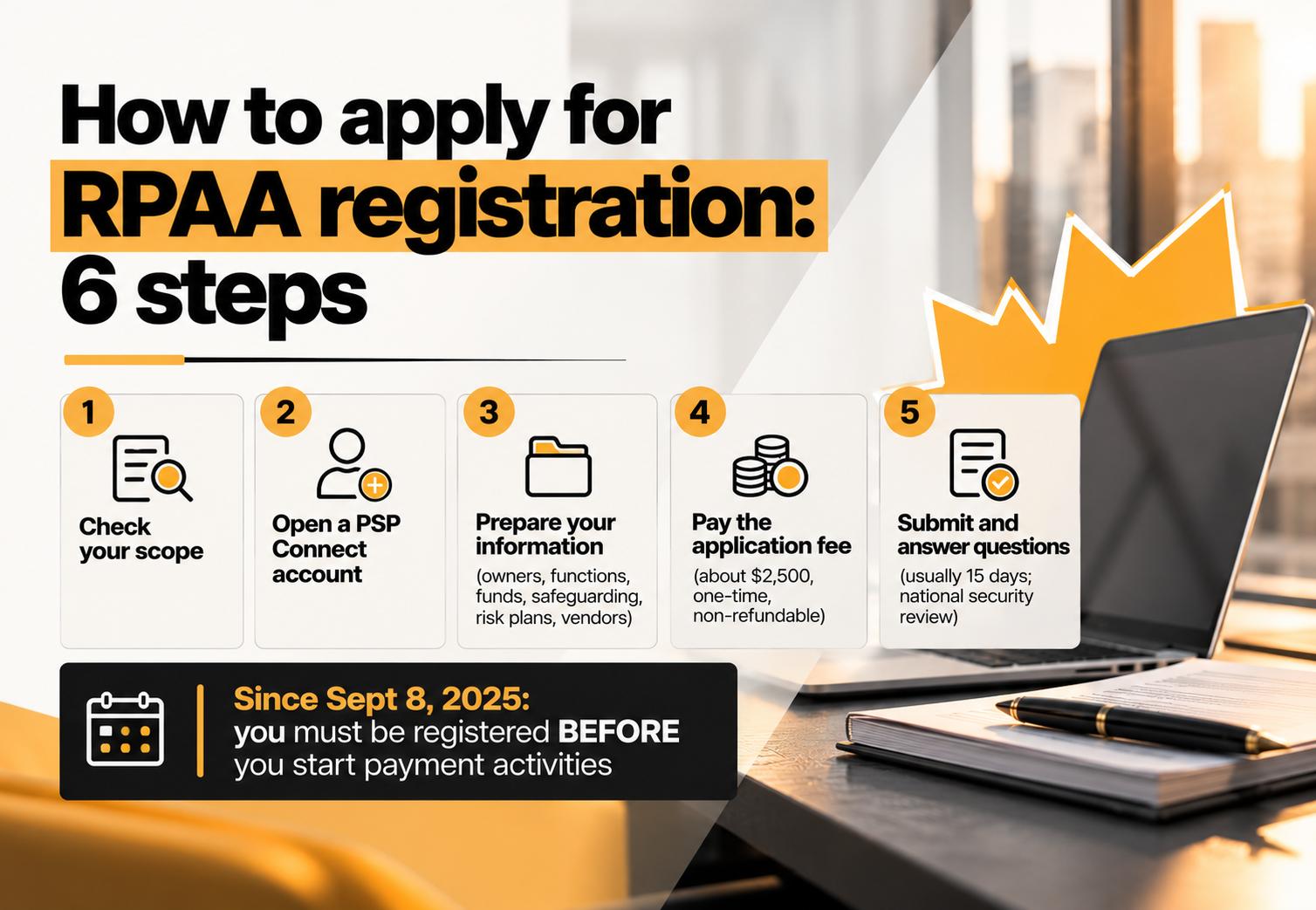
How to apply for RPAA registration: 6 steps
Step 1: Confirm your scope
Write down which of the 5 payment functions you perform, for whom, and from where. This becomes the backbone of your application. It also helps you answer the Bank's questions consistently later.
Step 2: Open a PSP Connect account
All applications go through PSP Connect, the Bank of Canada's online portal. You can't register without an account, so set it up early and decide who in your team will own it.
Step 3: Prepare your information
The application form follows section 29 of the RPAA. Expect to provide:
- Contacts and corporate details: legal and trade names, addresses, and your business structure and ownership
- Payment functions you perform, and your volumes and users
- End-user funds: whether you hold them, and how you safeguard them (for example, a trust account, or insurance or a guarantee)
- Risk management and incident response framework: how you identify, manage and report operational risks and incidents
- Third-party service providers and affiliates your payment services depend on
- Other registrations, such as FINTRAC or provincial licences
Step 4: Pay the application fee
The fee is one-time and non-refundable. It was set at $2,500 and rises with inflation each January. The Bank publishes the current amount in its Fee Bulletin. Payment is usually by credit card in PSP Connect. The Bank only starts reviewing your application once the fee is paid.
Step 5: Submit, then answer the Bank's questions
After you submit, PSP Connect confirms receipt, and you can't cancel a submitted application. The Bank may ask for more information. You'll usually have 15 days to reply, and in some cases only 24 hours. Your application is also shared with the Department of Finance, which carries out a national security review, and with FINTRAC.
Step 6: Get your decision
If you're approved, you're added to the Bank's public registry of PSPs, and you can start (or continue) your payment activities. If you're refused, you can ask for a review within 30 days, and the Bank must decide within 90 days.
How long does RPAA registration take?
The Bank doesn't publish a fixed review time. It depends on how complete your application is, how quickly you answer questions, and the national security review. The safest plan is to apply as early as possible, because you can't start in-scope payment services until you're registered.
The most common delays are:
- a business description that's too vague
- safeguarding arrangements that don't match the real account setup
- vendors and outsourcing that aren't explained
- answers that contradict your policies
Our guide to where RPAA applications break down covers these in detail.
After you register: what you must keep doing
Registration isn't the end. Registered PSPs must:
- File an annual report through PSP Connect by March 31 each year, covering the previous year. See our annual report readiness guide.
- Pay the annual assessment fee.
- Notify the Bank at least 5 business days before a significant change or a new payment activity.
- Report incidents without delay, such as outages or breaches that affect users or their funds.
- Keep your risk management, incident response and safeguarding in place and up to date, including oversight of your third-party service providers.
Frequently asked questions
Who must register under the RPAA?
Any business that performs payment functions for end users as a service in its own right, with a place of business in Canada or services directed to people in Canada. Banks and other already-regulated financial institutions are excluded.
How much does RPAA registration cost?
The Bank of Canada application fee is about $2,500. It's one-time and non-refundable, and it's adjusted for inflation each year. Registered PSPs also pay an annual assessment fee.
Where do I apply for RPAA registration?
Online, through the Bank of Canada's PSP Connect portal.
Can I operate while my application is being reviewed?
Since September 8, 2025, new PSPs must be registered before they perform retail payment activities. Plan your launch around the review time.
Do foreign payment companies need to register?
Yes, if they direct payment services to end users in Canada, even without an office in Canada.
Is RPAA registration the same as FINTRAC MSB registration?
No. They're separate regimes. The Bank of Canada supervises operational risk and safeguarding under the RPAA, and FINTRAC supervises anti-money laundering. Many payment companies need both.
AML Incubator helps payment companies check their scope, prepare RPAA applications, build risk management and safeguarding frameworks, and stay compliant after registration.
Get help with RPAA registration
Sources: Bank of Canada, registration · Bank of Canada, step-by-step application guide · Retail Payment Activities Act