Can an AI Compliance Officer Get You Fined? What FINTRAC Actually Thinks (2026)
Every department is getting the "we could probably automate this" conversation right now. In support, sales, content. And lately, even in compliance, which is a strange one to hear, because compliance is the department built entirely around the question "who's responsible if this goes wrong."
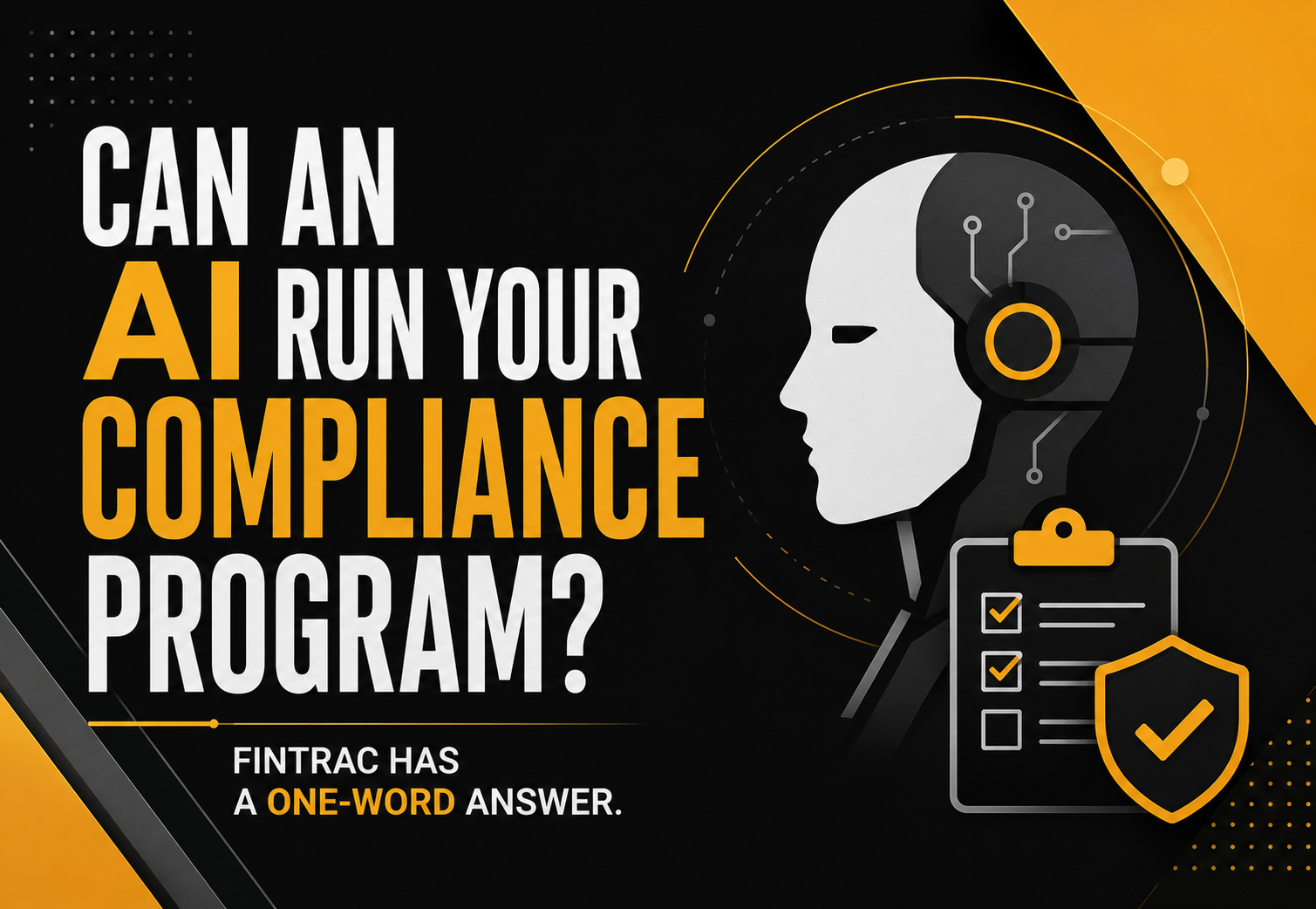
Can an AI Compliance Officer Get You Fined? What FINTRAC Actually Thinks About Automation
It goes like this: hook up an AI tool to your transaction monitoring, let it flag the risky stuff, skip the compliance hire, keep the budget. It sounds efficient & the obvious 2026 move.
A joint OSFI and Financial Consumer Agency of Canada report tracked AI adoption at federally regulated financial institutions climbing from roughly 30% in 2019 to 50% in 2023, with adoption projected to reach 70% by 2026. Every one of those institutions still needs a human compliance officer.
The tools got smarter but the accountability requirement didn't move an inch.
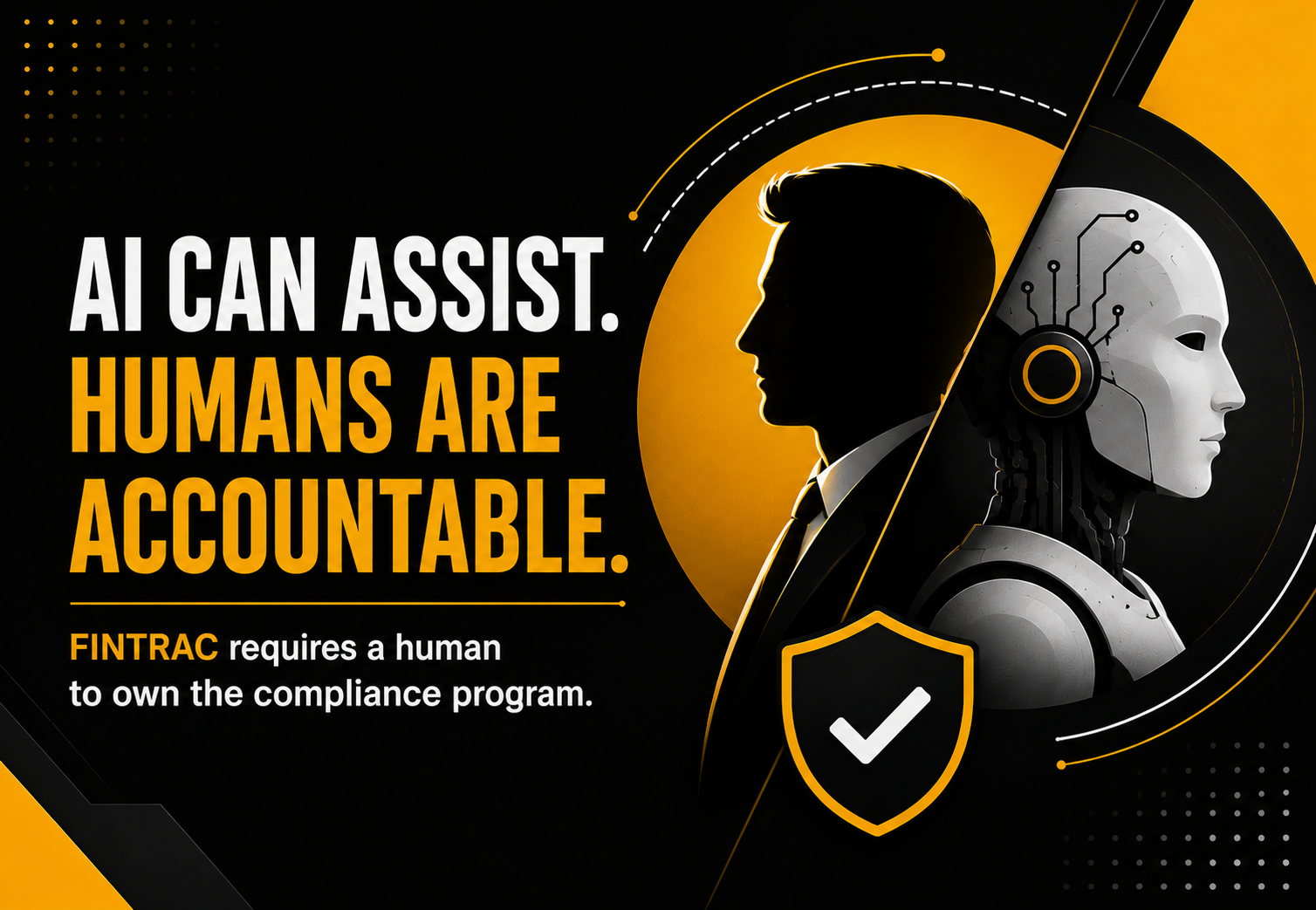
FINTRAC has already told you the answer, though.
It's a NO. A BIG no!
An AI compliance officer isn't a recognized role under Canadian AML law, and treating one like it is can get an entity fined.
Can an AI Be Your FINTRAC Compliance Officer? The Regulation Says "Person."
Under the Proceeds of Crime (Money Laundering) and Terrorist Financing Regulations, a reporting entity has to appoint someone to implement its compliance program.
FINTRAC's own compliance program requirements guidance spells out what that person actually needs: the authority to make changes to the program, real knowledge of how the business operates, and an understanding of the money laundering and terrorist financing risks specific to their sector. They're also expected to be able to sit down with senior management and talk through what's going wrong, which is a strange thing to picture an AI compliance tool doing in a boardroom.
None of that is an accident FINTRAC will eventually clean up in a future amendment. It's the point of the role, and it's why an AI compliance officer in Canada isn't a legally viable substitute for a human one, no matter how good the model is.
The Five Elements of a Compliance Program, and Why AI Can't Own Any of Them
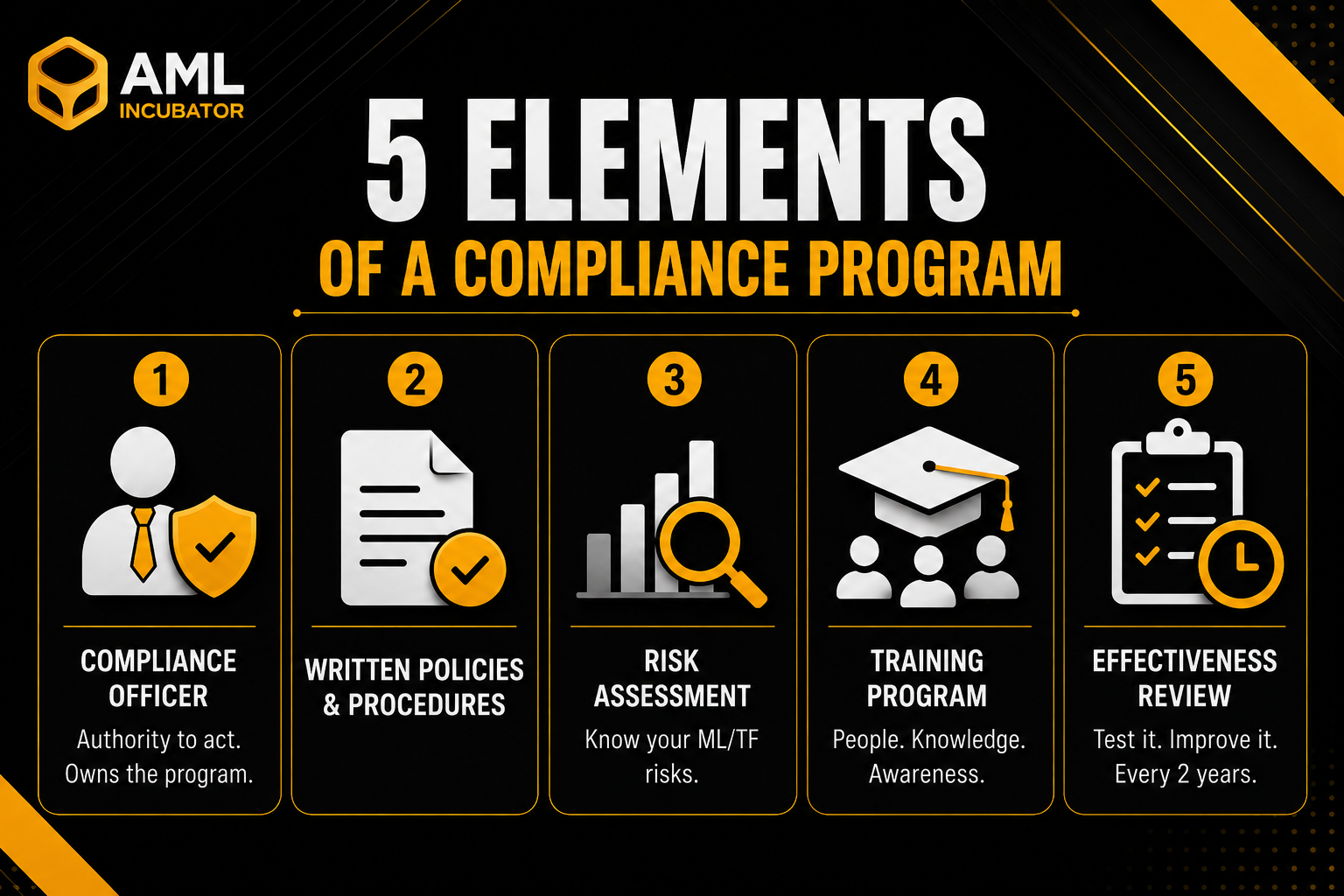
The compliance officer requirement doesn't sit on its own. FINTRAC's guidance builds the entire compliance program around five elements, and it treats them as one package, not five separate boxes to tick.
1) A compliance officer with the authority to act on what the program finds
2) Written compliance policies and procedures
3) A documented risk assessment of the money laundering and terrorist financing risks specific to the business
4) An ongoing training program and training plan
5) A two-year effectiveness review that actually tests whether the program works
AI can feed information into every one of those five elements. It can help build the risk assessment, surface gaps in the training program, and monitor transactions under the policies and procedures.
What it can't do is own the element, sign off on it, or stand behind it when FINTRAC asks who's responsible. That's still a person's name on the file.
Where AI Compliance Tools Actually Fit at FINTRAC-Regulated Businesses
FINTRAC has never said AI is off-limits in an AML program. Automated transaction monitoring, AI-assisted screening, machine-generated risk scores; normal stuff in 2026, and a lot of it genuinely improves a program's coverage. FATF's guidance on new technologies has spent most of this year encouraging firms to use AI for exactly this kind of work, so this isn't some Canada-only quirk.
That's roughly how FINTRAC itself works from when it talks about technology in an AML program: tools that increase detection capability are welcome, tools that replace judgment are not.
A risk-scoring engine that surfaces the top slice of transactions for a human to review is a detection tool.
A risk-scoring engine that auto-clears everything else without anyone looking at what it cleared has become the decision-maker, and decision-makers need a name attached to them.
The line was never "AI, yes or no." It's who's accountable when the AI is wrong.
An AI system can draft a suspicious transaction report. Fine.
A human still has to read it, understand it, and sign it before it goes through FINTRAC's reporting system.
An AI system can flag a wire transfer as high-risk. Also fine.
But somebody with a name and a job title has to decide what happens to that flag next.
The moment a business starts treating the model's output as the final answer instead of a first draft, the AML compliance program stops being a compliance program.
Why "The AI Did It" Won't Work as a FINTRAC Defence
This is where a lot of founders get caught off guard.
The reporting entity is responsible for its own compliance program. Full stop. The business is supposed to appoint a qualified compliance officer.
If FINTRAC shows up and finds a chatbot sitting where a compliance officer should be, that gets scored as a program design failure in the same category, the same penalty framework, as any other gap in the program. Very serious violations already carry administrative monetary penalties up to $500,000 per violation for an entity. If that number sounds familiar, we walked through the fuller penalty structure in our piece on operating as an unregistered MSB in Canada.
So no, blaming the model just adds a line item to the gap analysis.
Vendor Contracts Don't Transfer the Regulatory Risk
A lot of businesses buy their AML automation instead of building it, which is usually the right call. But the purchase agreement with an AI vendor is a commercial contract, not a compliance program. It might allocate liability between the two companies if something breaks. It does nothing to change who FINTRAC holds accountable, because the reporting entity's obligations under the PCMLTFA sit with the reporting entity, full stop, regardless of whose logo is on the software.
That makes due diligence on an AI vendor part of the compliance program. Before the tool goes live, someone at the business needs to understand roughly how it makes decisions, what it was trained on, how often it changes, and what happens when it's wrong. If nobody can answer those questions, the business has outsourced its judgment along with its workload, and that's exactly what FINTRAC's guidance was written to catch.
The Real Automation Risk: Alert Fatigue, AND Not the AI Itself
Businesses that get burned here automated one part of the workflow and it worked. Then they automated the next part and eventually nobody on staff was reading the alerts anymore, because the alerts had stopped feeling like anyone's job.
That's exactly what FINTRAC's guidance is designed to catch.
A compliance officer who can't explain why a transaction was cleared isn't meeting the "knowledge of the business" bar, even if the clearing decision technically happened inside a well-built model somewhere upstream. Two-year effectiveness reviews look at judgment and outcomes.
If your AI flags something and a human closes the alert four seconds later without reading it. Call it what it is: a rubber stamp with a login screen attached.
Training and Risk Assessment: The Two Places AI Slips Past Oversight
Alert fatigue gets the attention because it's visible, somebody stops reading the alerts and it shows. The training program and the risk assessment are where AI slips through more quietly, because nobody's watching for it there.
If a model is doing part of the monitoring, the people relying on its output need to understand what it's good at, where it tends to be wrong, and what a plausible-but-incorrect result looks like. A training program that covers client identification and reporting but never mentions the AI tool everyone actually uses day to day has a gap in exactly the area FINTRAC's guidance is meant to cover.
The risk assessment has the same problem.
It's supposed to describe the actual money laundering and terrorist financing risks of the business, kept current as the business changes. Adding an AI layer to transaction monitoring is a change to how risk gets identified and managed, so the risk assessment needs to say so. One that still describes a manual review process the business retired two years ago is evidence the program isn't being run by anyone who actually understands it.
What an AI-Assisted Compliance Program Needs to Hold Up Under Review
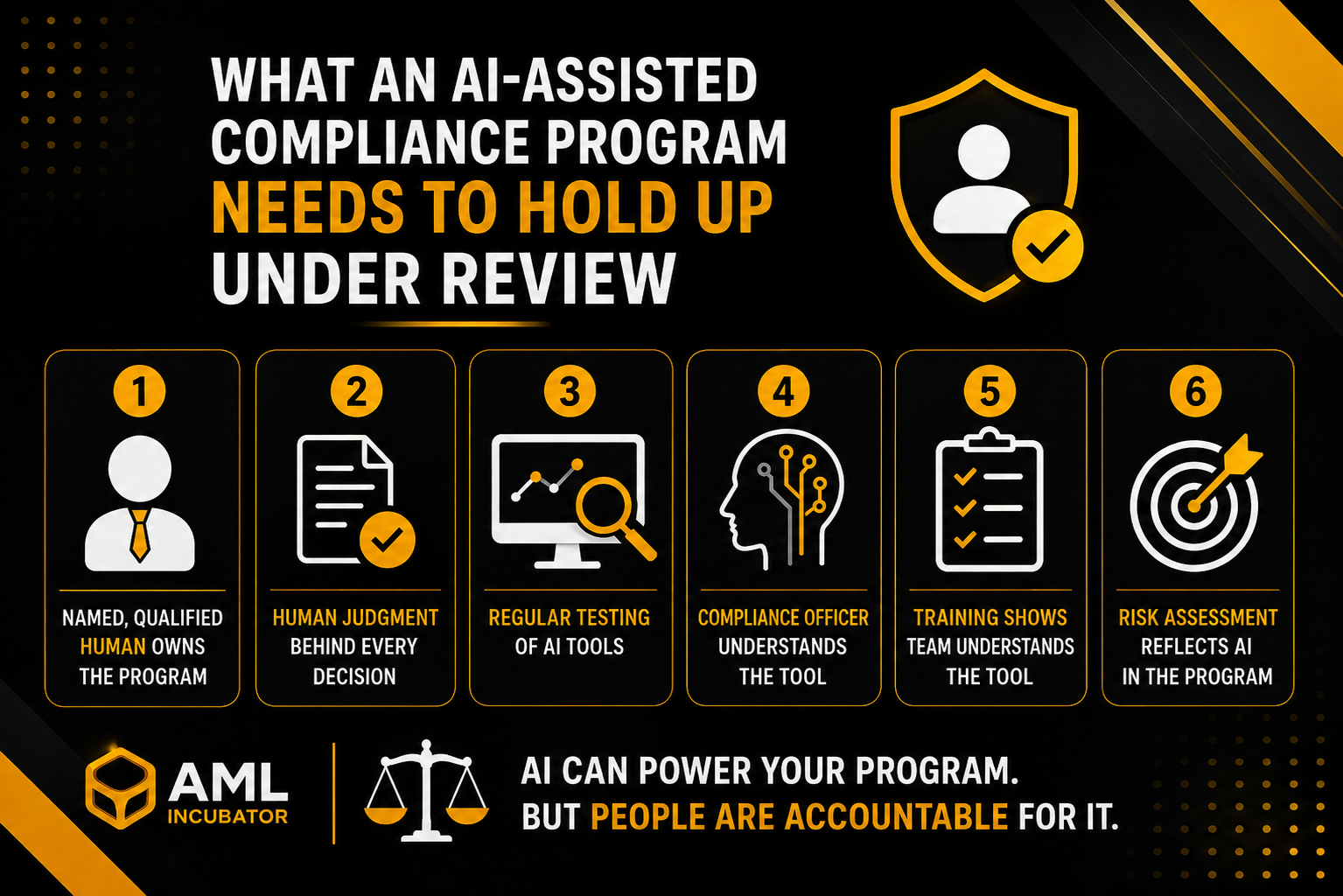
A program that survives a FINTRAC review with AI in the mix usually has a few things in common.
1) A named, qualified human who actually owns the program
2) A paper trail showing why a human agreed or disagreed with what the model recommended, because "the system said so" isn't an explanation.
3) Regular testing of the AI tool itself, the same way any other control gets tested, so it doesn't quietly drift into blind spots.
4) A compliance officer who can explain how the tool works
5) Training records showing staff understand what the tool does and where it tends to be wrong
6) A risk assessment that actually reflects the AI tool's role in the program, not the manual process it replaced
None of that is exotic.
It's the same bar FINTRAC has always set; a person who understands the risk, has the authority to act on it, and can explain the call if someone asks.
What FINTRAC Actually Expects to See in Your AI Paper Trail
Most FINTRAC record-keeping requirements were written before generative AI existed, but the underlying principle applies just fine here: if a record supports a compliance decision, it needs to be kept, and it needs to be produced on request. Most compliance records carry a minimum five-year retention period, and that doesn't change because the record started life as a model output instead of a handwritten note.
In practice, a defensible AI paper trail usually includes what the tool flagged and why, who reviewed the flag and when, what they decided and their reasoning, and a record of any material change to the tool itself.
Where This Is Headed: OSFI's Guideline E-23 and the Direction AI Governance Is Taking
FINTRAC isn't the only regulator paying attention to this.
The Office of the Superintendent of Financial Institutions finalized an updated Guideline E-23, which sets out formal model risk management expectations, explicitly covering AI and machine learning, for federally regulated banks, insurers, and trust companies. It takes effect May 1, 2027.
FINTRAC reporting entities aren't OSFI-regulated and won't fall under E-23 directly, so this isn't a new deadline to add to the calendar.
What it signals is the direction Canadian financial regulation is heading: governance, testing, and named accountability for AI models, which is exactly the kind of human ownership FINTRAC's compliance program guidance already expects. Building that habit now, before a regulator requires it by name, is cheaper than building it under examination pressure later.
FAQ: AI Compliance Officers and FINTRAC
Can an AI legally be a FINTRAC compliance officer in Canada?
No. FINTRAC's regulations require reporting entities to appoint a person as compliance officer, with the authority and business knowledge to run the program. An AI tool can't meet that standard on its own.
Does FINTRAC allow AI in AML compliance programs at all?
Yes. FINTRAC doesn't prohibit AI-assisted monitoring, screening, or risk scoring. The requirement is that a qualified human reviews and takes responsibility for what the AI produces, rather than the AI operating unsupervised.
What happens if FINTRAC finds an unsupervised AI running compliance decisions?
It's treated as a compliance program design failure, subject to the same administrative monetary penalty framework as any other gap up to $500,000 per violation for very serious violations by an entity.
Can a business blame its AI vendor if a report is missed?
No. The reporting entity, not the software vendor, is responsible for its compliance program under the PCMLTFA. The AI tool doesn't carry any of that legal accountability.
Does FINTRAC require testing or validation of the AI tools themselves?
Not by that specific name, but the two-year effectiveness review already requires testing whether the compliance program works in practice. If AI is part of the program, testing whether the program works means testing whether the AI is working the way it's supposed to.
What records should a business keep about how its AI tool made a decision?
At minimum, what the tool flagged, who reviewed it, what they decided, and why. Most compliance records need to be kept for a minimum of five years and produced on request, and there's no carve-out for records that started as AI output.
Is a small MSB held to a lighter standard than a bank when it comes to AI oversight?
FINTRAC's compliance program requirements scale to the size and risk of the business, but they don't disappear for smaller reporting entities. A small MSB still needs a qualified compliance officer who understands how its AI tools work, even if that person wears several other hats too.
Get In Touch
If your AML program is leaning on automation and you're not sure the human oversight underneath it would hold up under a review, it's better to find that out now than during an examination.
AML Effectiveness Review: a structured review of your program, including how your AI compliance tools are governed, documented, and overseen, benchmarked against current FINTRAC expectations.
CAMLO and MLRO Services: an embedded, qualified compliance officer who meets FINTRAC's actual standard for authority and sector knowledge, without the cost of a full-time hire.
FINTRAC MSB Registration: for firms that need their program, including any AI tooling, structured correctly from the start.
Book a discovery call and we'll walk through where your program actually stands.