Crypto ATM Compliance in Canada: How to Survive FINTRAC Scrutiny (2026)
Crypto ATMs face rising fraud scrutiny and FINTRAC pressure in Canada. Here is the compliance and business model shift keeping Bitcoin ATM operators registered, banked, and in business.
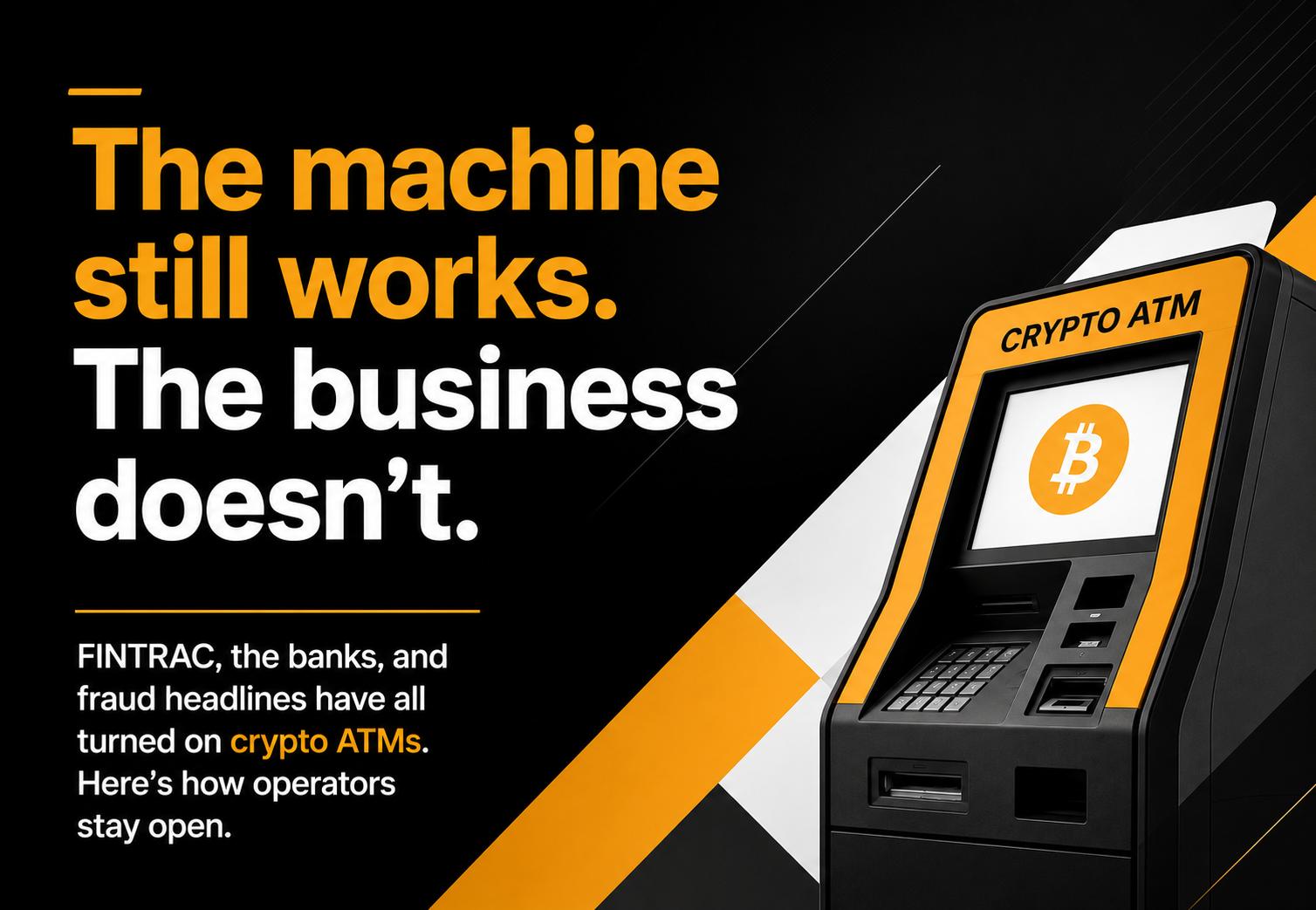
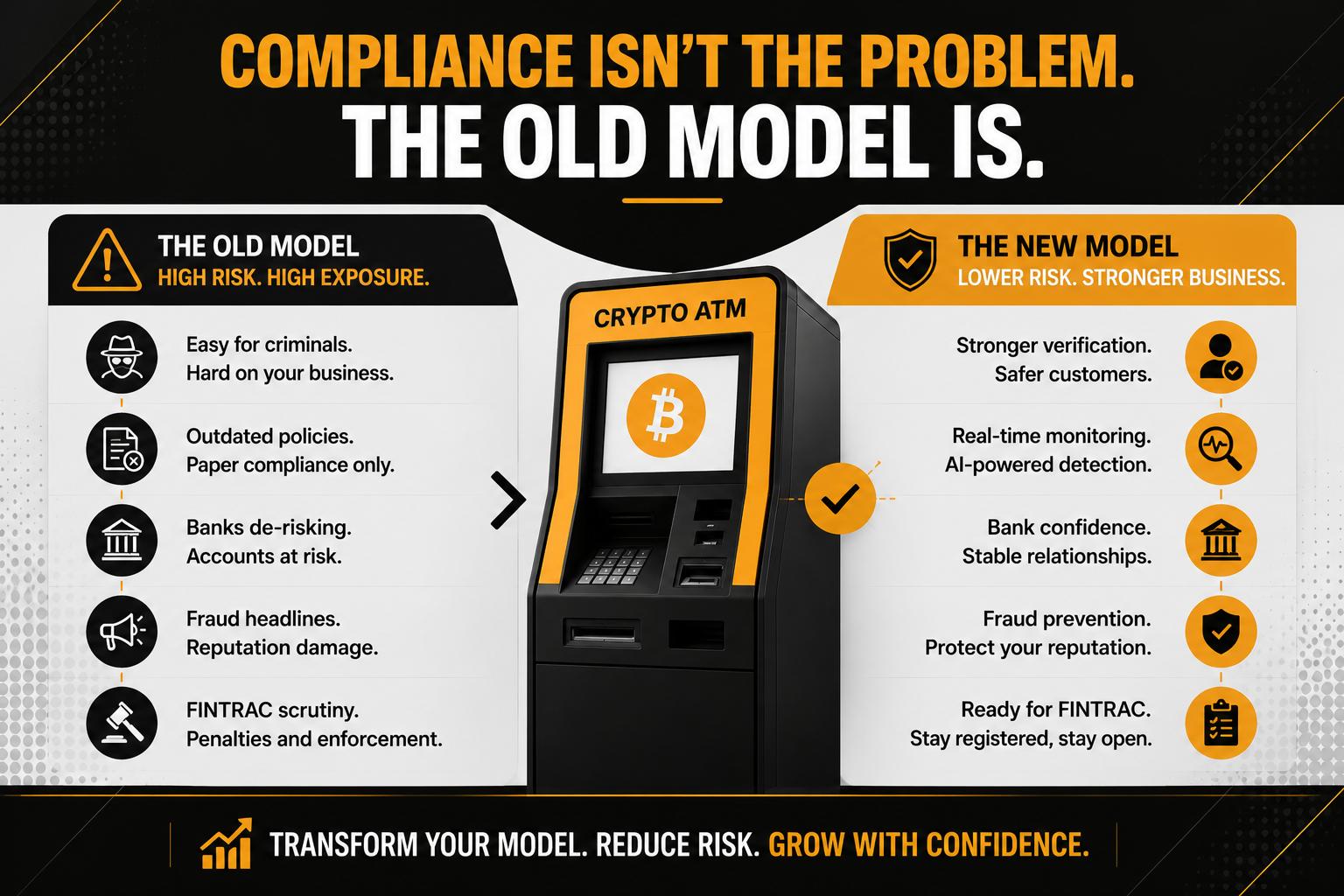
Banking partners have gotten harder to keep. Host locations chosen for foot traffic are now a reputational liability nobody priced in. And a compliance program written at registration, never rebuilt as the machine count grew, is the single most common reason operators lose the relationships that keep them in business. This service exists because operators in this position need their registration, their machines, and their compliance function rebuilt around how the business actually runs today — not a new registration, and not an exit. We call it the Crypto ATM Transformation Program.
Why This Service Exists Now
Crypto ATM operators in Canada have been registered as money services businesses dealing in virtual currency since the category was created, and for years the compliance burden was proportionate to what regulators actually checked. That has changed. FINTRAC's enforcement posture has tightened, and Canadian regulators have published fraud typologies — rapid, first-time, high-value cash-outs consistent with scam deposits — that are now specifically associated with virtual currency ATM transactions. An operator whose transaction limits and identity verification thresholds have not moved since launch is being measured against a fraud pattern that did not exist when those thresholds were set. Read more about whether your business qualifies as an MSB on the AMLI blog.
Banking relationships have followed the same trajectory. Several institutions have grown uncomfortable with the crypto ATM model generally, and operators are finding accounts harder to open, harder to keep, and subject to more scrutiny at renewal. Host and retail partnerships carry a version of the same risk: a location chosen purely for transaction volume can become the reason a bank, a regulator, or a journalist takes an interest in the business.
None of this means the crypto ATM model is finished. It means the version of the model that was compliant in the year a business launched is no longer the version that survives an examination, a banking review, or a fraud investigation today. AMLI built the Crypto ATM Transformation Program for operators who want to close that gap while staying in the business, rather than closing the business itself.
The Six Components
Every engagement is built around six components. They are delivered together, because a machine-level fix without a rebuilt compliance program; or a rebuilt program without host vetting, leaves the same exposure in a different place.
1. Full Regulatory Registration and Program Rebuild
What it involves.
AMLI confirms your MSB registration for virtual currency dealing is accurate and current, then rebuilds the compliance program underneath it so it reflects how your machines operate today rather than how they operated when the business first launched. Our FINTRAC MSB registration team handles the filings directly, rather than leaving an operator to interpret FINTRAC correspondence alone.
AMLI Analysis: The most common gap we find is not an invalid registration; it's a compliance program that was accurate at filing and has not been touched since. A program that predates your current machine count, your current host locations, or your current transaction volumes is not a program an examiner will treat as current, regardless of how the registration itself reads.
2. Machine Level Compliance Re-Engineering
What it involves.
AMLI works directly with your technology provider to raise identity verification standards at appropriate transaction thresholds, tighten daily and per-transaction limits, and embed sanctions and politically exposed person screening into the kiosk workflow itself rather than leaving screening as a manual step that depends on someone remembering to do it.
AMLI Analysis: Controls that live in a policy document and controls that live in the kiosk software are not the same control. The second kind is the one that actually changes outcomes, because it doesn't depend on a person choosing to follow the procedure at 11pm on a Saturday.
3. AI Assisted Fraud Pattern Detection
What it involves.
AMLI layers AI-driven transaction monitoring on top of your existing systems, so that deposit patterns consistent with scam-related cash-outs; the rapid, first-time, high-value transactions that recur across published crypto ATM fraud cases are flagged and reviewed before the funds leave the machine, not after.
AMLI Analysis: The distinction that matters here is timing. A suspicious transaction report filed after the money is gone documents the fraud. A flag that fires before the cash-out completes is the only version of monitoring that actually protects the victim, and it's also the version regulators increasingly expect to see evidenced in an effective program.
4. Host and Retail Partner Vetting
What it involves. AMLI assesses where your machines are placed and who you're partnered with, and helps you decide which locations are worth the reputational exposure they carry and which are quietly putting your entire registration at risk.
AMLI Analysis: Foot traffic and risk exposure are two different measurements, and most operators have only ever tracked the first one. A location can be your best-performing machine and your worst compliance liability at the same time; the vetting exercise is what tells you which locations are which.
5. Outsourced CAMLO Coverage Built for ATM Operations
What it involves. AMLI's outsourced CAMLO service gives you a named, accountable compliance officer who understands how ATM transaction volume, cash handling, and kiosk software interact — not someone applying a generic MSB template to a business model they've never actually seen in operation.
AMLI Analysis: A CAMLO who has only worked with exchanges or remittance businesses will build controls for the wrong transaction pattern. ATM compliance has its own operational logic: cash-in behavior, kiosk uptime, host relationships, and the officer overseeing your program needs to have actually worked inside it.
Signs You Need This Conversation Now
Read the list below honestly. If more than a couple describe your operation, have this conversation before an examiner, a journalist, or a fraud victim's family forces it on you.
-
Your machines have no transaction limit that reflects the fraud patterns Canadian law enforcement has already published.
-
Your compliance program was written at registration and hasn't been touched since your machine count changed.
-
You don't know, without checking, how many suspicious transaction reports your business has filed in the past year.
-
Your banking relationship has gotten noticeably harder to maintain, and no one on your team has asked why directly.
-
You've never had an outside party independently test whether your transaction monitoring actually catches what it's supposed to catch.
-
Your host locations were chosen for foot traffic, and reputational or compliance risk was never part of that conversation.
What Survival Actually Looks Like
-
Confirm your registration and program actually reflect your current operations, not your operations from the year you launched.
-
Rebuild your risk assessment around the fraud typologies regulators and law enforcement have specifically connected to crypto ATMs.
-
Introduce machine-level verification and transaction limits that make the fastest and most damaging scam patterns significantly harder to execute.
-
Layer AI-assisted monitoring into your existing systems so suspicious deposit patterns are caught within minutes rather than discovered weeks later in a report.
-
Vet every host location against the reputational and regulatory risk it actually carries, not just the foot traffic it generates.
-
Put a compliance officer in place who has the authority, the access, and the actual operational understanding to do the job properly.
-
Schedule an independent effectiveness review before FINTRAC schedules one for you.
AMLI Analysis: Operators sometimes ask which of these seven steps to prioritize if budget or timeline is tight. The honest answer is that steps one and two are the foundation everything else sits on; a rebuilt monitoring system or a newly vetted host list doesn't hold up in an examination if the underlying risk assessment still describes a business that no longer exists.
Why AML Incubator?
AMLI provides outsourced Chief Anti-Money Laundering Officer services to reporting entities across Canada, including crypto ATM and Bitcoin ATM operators specifically. Learn more about our team and history.
Our practice covers FINTRAC MSB registration and renewal, AML program design and effectiveness review, FINTRAC examination support, and CAMLO outsourcing for entities that need an active, embedded compliance function without hiring one full-time.
We have rebuilt compliance programs for operators whose registration predated their current machine count. We have worked directly with kiosk technology providers to embed screening into machine workflows. We have vetted host and retail partnerships for reputational exposure operators hadn't previously measured.
These are things we have done for operators in the same environment you're operating in now.
We are not a law firm, and we do not provide legal advice. For the legal components of any regulatory response, we work alongside legal counsel. The compliance execution is our role.
Frequently Asked Questions
Do we need to replace our existing kiosk software?
Not necessarily. The machine-level re-engineering component works with your existing technology provider to raise verification thresholds and tighten transaction limits within the current system. Whether a technology change is needed depends on what your current kiosk software is actually capable of enforcing — that's assessed directly rather than assumed.
Will this trigger a FINTRAC examination we weren't already facing?
No. The program is designed to get ahead of an examination, not invite one. Confirming and rebuilding your registration and compliance program is a standard compliance activity, not a disclosure event.
What happens to host locations that don't pass vetting?
That depends on what the vetting finds and what the location is worth commercially. Some relationships can be brought into an acceptable risk profile with changes to how the machine there is operated. Others are recommended for exit. The vetting process produces a location-by-location assessment, not a blanket recommendation.
Does the outsourced CAMLO replace our existing compliance staff?
Not automatically. For operators without an internal compliance function, the CAMLO service fills that role directly. For operators with existing staff, the outsourced CAMLO typically works alongside them, providing the ATM-specific operational expertise most internal hires haven't had the chance to build.
Are we required to diversify away from the ATM model?
No. The diversification advisory is available for operators who want to reduce their exposure to the cash-in kiosk model, but it is not a requirement of the program. Many operators complete the other five components and keep their ATM footprint exactly as it is.
I've heard Canada is considering banning crypto ATMs entirely. Does this program still make sense?
Yes, and it's worth being direct about where things stand. Canada's Spring Economic Update 2026 proposed making crypto ATM operation a criminal offence nationwide, but as of this writing that remains a proposal. It requires separate legislation to pass both Houses of Parliament and receive Royal Assent, and no enactment timeline has been confirmed. Operators registered today keep their current legal status unless and until that changes. Whatever happens with the proposal, a current registration, a defensible risk assessment, and a clean compliance record are exactly what you'd also need if the path ahead turns out to be a wind-down or a sale rather than a rebuild — so the work isn't wasted either way. Talk to us before assuming any path is closed off.
How is this different from a wind-down or a sale of the business?
It's the opposite starting point. This program is for operators who want to keep running crypto ATMs and need the registration, the machines, and the compliance function rebuilt to survive current scrutiny. Operators who are instead considering closing the business, pivoting to an OTC model, or selling the MSB entity should look at AMLI's separate guidance on those three paths.
Get In Touch
Book a Discovery Call to walk through your current registration, your machine count, and your host locations, and find out where the gaps are before someone else does.
These AMLI services are the ones most directly relevant to operators in this position:
-
CAMLO and MLRO Services — Active compliance function ownership for reporting entities that need an embedded CAMLO without hiring one full-time.
-
AML Audit and Effectiveness Review — A structured review of your AML program documentation, risk assessment, and evidence trail against current FINTRAC standards.
-
FINTRAC MSB Registration — Registration, renewals, updates, and regulatory correspondence management for MSBs at any stage.