The Cost of Compliance: Market Salaries, Software Pricing, and Review-Ready Budgets (2026)
Compliance spending is often underestimated because it is an operating cost made up of people, process, evidence, and tooling that must run continuously. This blog provides salary anchors, published pricing examples, and practical budget patterns that show what “review-ready” compliance costs as complexity grows.
Why People Search for Compliance Cost and Compliance Salaries?
Most firms search for compliance costs when they hit a decision point: hiring the first compliance role, selecting an AML (anti-money laundering) stack, preparing for bank onboarding, or responding to audit and supervisory pressure.
The budgeting problem is that compliance cost is usually more than the cost of writing a program. It is the cost of operating controls and producing proof that those controls ran consistently over time.
AMLI Analysis: Many budgets fail because they fund documents and tools but underfund ownership, QA discipline, and evidence retrieval speed.
What Compliance Cost Actually Includes?
Compliance cost is the total recurring spend required to meet legal obligations, satisfy supervisory expectations, and reliably produce evidence of control execution.
That spend typically sits in five buckets:
-
People (ownership and execution)
-
Tools and technology (screening, monitoring, case management, evidence storage)
-
Governance and operating cadence (reviews, approvals, QA, oversight reporting)
-
External support (legal input, independent testing, specialist advisory)
-
Event-driven spikes (launch readiness, remediation, partner deadlines)
AMLI Analysis: Teams underestimate cost when they treat compliance as a setup project instead of an operating discipline.
What This Means for Budgeting?
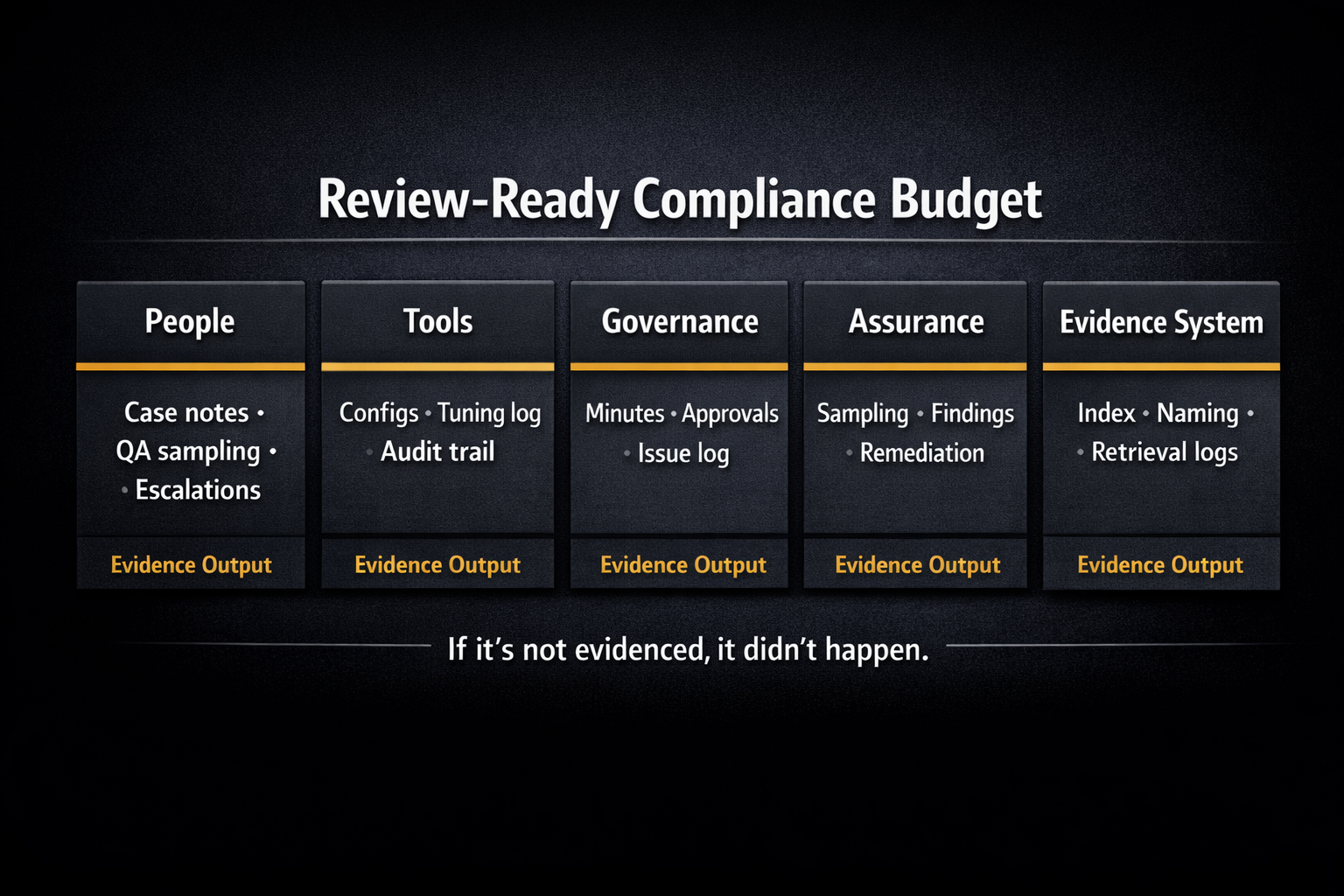
Use this as a practical checklist when building a review-ready compliance budget.
|
Budget line |
What it covers |
Common under-budgeted item |
“Review-ready” evidence output |
|
People |
Compliance ownership, analysts, QA, escalation |
Second-line QA time |
Dated case notes, QA sampling results, escalation records |
|
Tools |
Screening, monitoring, case management |
Workflow configuration and tuning support |
Tool configs, tuning decisions, alert disposition, audit trail |
|
Governance |
Oversight cadence, approvals, reporting |
Documented decisions |
Minutes, approvals, issue logs, remediation closure evidence |
|
Assurance |
Independent testing, targeted reviews |
Evidence packaging time |
Testing scope, sampling records, findings and remediation tracking |
|
Evidence system |
Retention, access control, retrieval process |
Consistent storage structure |
Evidence index, naming conventions, retrieval logs |
Legal Requirements, Regulatory Expectations, and Best Practice
This is where cost estimates usually break down. “Compliance” means different things depending on who is asking.
Legal requirements
These are obligations in statutes and regulations. In FINTRAC examinations, reporting entities are expected to produce required records within 30 days of a request by an authorized officer.
Regulatory expectations
These reflect how supervisors interpret whether a program is effective in real operations. This is where evidence quality, QA outcomes, and governance cadence become decisive.
Industry best practice
These are patterns that increase defensibility even when not written as a strict rule, such as consistent QA sampling, documented tuning decisions, and standardized evidence folders.
AMLI Analysis: Cost spikes happen when firms discover that documented controls do not equal operated controls.
Salary Benchmarks: Market Anchors
Salaries vary by jurisdiction, sector, and accountability. Pay rises sharply when a role owns decisions that must hold up to external scrutiny. These salary anchors are directional and will vary materially by seniority, city, sector, and the level of regulatory accountability carried by the role.
-
United States (broad compliance officer anchor)
The U.S. Bureau of Labor Statistics reports the median annual wage for compliance officers as $78,420 (May 2024).
For budgeting purposes, teams often translate this into three directional bands by responsibility:
Junior/entry-level execution-focused roles commonly fall around $55,000–$70,000, mid-level roles with ownership over workflows, case decisions, or a product line often sit around $75,000–$100,000, and senior/accountable owner roles (e.g., Head of Compliance-level accountability, supervisory response ownership) frequently move into $110,000–$160,000+, depending on sector, geography, volume, and regulatory exposure.
-
Canada (regulatory compliance officer anchor)
Job Bank Canada reports a Canada-wide median hourly wage of $44.10 for “regulatory compliance officer” (wages updated November 19, 2025; reference period 2023–2024).
For budgeting, teams often translate this into three directional bands by responsibility:
Junior/entry-level execution-focused roles commonly budget around $30–$40/hour (roughly $62k–$83k/year at 40 hours/week), mid-level roles with ownership over workflows, case decisions, or a specific business line often sit around $40–$55/hour (about $83k–$114k/year), and senior/accountable owner roles with governance, supervisory response, and program defensibility responsibilities frequently move into $55–$75+/hour (roughly $114k–$156k+/year), depending on sector, city, complexity, and regulatory exposure.
-
United Kingdom (MLRO accountability anchor)
Morgan McKinley’s UK salary guide shows London MLRO salary bands typically ranging from £90,000–£130,000 for mid-level MLRO roles, stepping up to £130,000–£180,000+ for senior MLRO/SMF17-level accountability, depending on sector, regulatory exposure, and firm complexity.
What founders actually need to budget for
Below is a planning table. It shows how responsibilities typically scale as programs mature.
|
Role |
Lean stage (directional) |
Growing program (directional) |
High-scrutiny program (directional) |
|
Compliance Analyst/Investigator |
1 role, execution-focused |
2–4 roles, throughput-driven |
scaled team, specialization by typology/product |
|
QA/Second-line sampling |
fractional time (often missing) |
dedicated part-time or 1 FTE |
formal QA function and reporting cadence |
|
Accountable Owner (MLRO / CRO / Head of Compliance) |
fractional or first full-time hire |
full-time owner and governance |
senior owner and supervisory response capacity |
|
Compliance Ops / Tool Admin (workflow and tuning) |
shared responsibility |
dedicated tuning discipline |
formal change control and approvals |
|
Assurance/Independent Testing |
periodic readiness check |
annual testing and targeted deep dives |
recurring assurance and remediation capacity |
AMLI Analysis: The common budget reset is moving from a junior executor hire to a senior owner who can defend decisions, run governance, and keep evidence coherent.
Don’t underscore the “review-ready stack.
Founders often budget for “screening” and forget the rest of the operating stack. A review-ready program typically includes:
-
Identity verification (KYC/KYB/UBO), where applicable
-
Sanctions/PEP/adverse media screening
-
Transaction monitoring (rules/models and tuning workflow)
-
Case management and audit trail (or a workflow layer)
-
Secure evidence storage (retention, access controls, naming conventions)
-
Reporting workflow support (escalation logs, filing evidence, decision rationales)
-
Vendor oversight artifacts (config change logs, periodic effectiveness reviews)
What tool pricing often does not include (budget it separately)
-
Integration, data mapping and engineering time
-
Workflow setup, rules tuning, threshold calibration
-
QA sampling and rework loops
-
Evidence indexing, exports, and retrieval drills
Turning pricing into a budget (the reality)
-
If your tool price is low but your match rate is high, the real cost becomes analyst time and QA rework.
-
If your plan is usage-capped, budget for what happens when you exceed the cap: upgrades, overage rules, and higher review workload.
AMLI Analysis: Screening cost is rarely the limiting factor. The real cost is review workload and evidence quality: decision notes, rationale, and consistency.
Transaction Monitoring and Alert Operations: Where Costs Scale?
Tool pricing varies (bundled suites, enterprise quotes, and volume-based structures). The operational math stays the same; monitoring costs grow because each alert creates repeatable work:
-
triage and assignment
-
investigation and escalation
-
decision documentation
-
QA sampling and second-line review
-
tuning decisions and governance approvals
A safe way to estimate monitoring budget
Treat monitoring as two budgets:
-
Tooling budget (subscription or usage)
-
Human throughput budget (alerts × minutes per alert × QA rate)
Budgeting logic
-
Monthly investigation hours = alerts/month × minutes/alert ÷ 60
-
Monthly QA hours = investigation hours × QA rate
-
Total monthly hours = investigation hours + QA hours
-
Approx FTE = total monthly hours ÷ 160
Example (directional)
If you receive 600 alerts/month and average 20 minutes/alert, that is:
-
600 × 20 ÷ 60 = 200 investigation hours/month
If QA sampling is 15%, that adds: -
200 × 0.15 = 30 QA hours/month.
Total = 230 hours/month, which is approximately 1.4 FTE (before governance, tuning meetings, training, remediation work, and partner requests).
AMLI Analysis: The fastest way to burn budget is high alert volume with weak tuning discipline and inconsistent case notes.
Independent Testing, Audit Readiness, and Remediation Costs
Independent testing expectations vary by jurisdiction and sector. Cost usually depends on scope:
-
A policy-only review is cheaper, but it often misses operational gaps.
-
An implementation and evidence review is more intensive because it samples cases, validates workflows end-to-end, and tests whether the program produces consistent, retrievable proof.
The hidden cost is internal time. Even when external testing is scoped and priced, the largest expense is often
-
evidence gathering and packaging
-
fixing control gaps found in sampling
-
rebuilding workflows so the next review isn’t another scramble
-
standardizing case notes, rationale language, and approvals
AMLI Analysis: The largest cost driver is often internal effort: gathering evidence, fixing control gaps, and rebuilding workflows so the next review is not another scramble.
Canada Anchors: FINTRAC MSB Costs and RPAA Fees
Two Canada examples show why fees are rarely the true compliance cost.
FINTRAC MSB registration fee
FINTRAC states it does not charge registration fees for MSBs and foreign MSBs.
So the cost is the program: monitoring, recordkeeping, training, reporting workflows, and evidence retrieval.
FINTRAC explains that reporting entities must produce required records within 30 days of a request during an examination.
RPAA fees and cost recovery
The Bank of Canada’s supervisory policy sets a one-time, non-refundable registration application fee of $2,500 as of November 1, 2024, with CPI-based adjustment mechanics.
The bank also explains that it must recover the costs of supervising PSPs through a registration fee and an annual assessment fee, with regulations to finalize the assessment fee formula.
AMLI Analysis: When a supervisor asks for evidence, your cost is measured in retrieval speed and consistency, not in filing fees.
What Are You Actually Budgeting For?
If you want a review-ready program, you need a budget for workstreams that produce evidence repeatedly.
Governance cadence
-
approvals, oversight reporting, meeting minutes
-
issues tracking, remediation ownership, closure evidence
Monitoring operations
-
alert triage, investigation, escalation
-
decision rationales and audit trails
-
tuning records and approvals
-
QA sampling and outcomes tracking
Training evidence
-
role-based training, completion records, refresh triggers
Evidence system
-
retention, naming conventions, access controls
-
retrieval speed under deadline pressure
AMLI Analysis: Review-ready is an operating standard.
What “Review-Ready” Looks Like
A review-ready program can produce an evidence pack quickly because evidence is structured
A practical evidence pack usually includes:
-
Governance: minutes, approvals, decisions, issue log, remediation closure evidence
-
Monitoring operations: triage logic, escalation records, workflow evidence
-
Casework: dated case notes, rationale, disposition, supporting documents, audit trail exports
-
QA: sampling plan, sample selection method, QA results, failure themes, fixes
-
Tuning discipline: change log, rationale, approvals, pre/post impact notes
-
Training: role-based matrix, completion logs, refresh triggers
-
Evidence architecture: retention mapping, access controls, folder structure, naming conventions, retrieval logs
AMLI Analysis: Evidence architecture is what makes the program defensible under the deadline.
Why Do Costs Step Up as Complexity Grow?
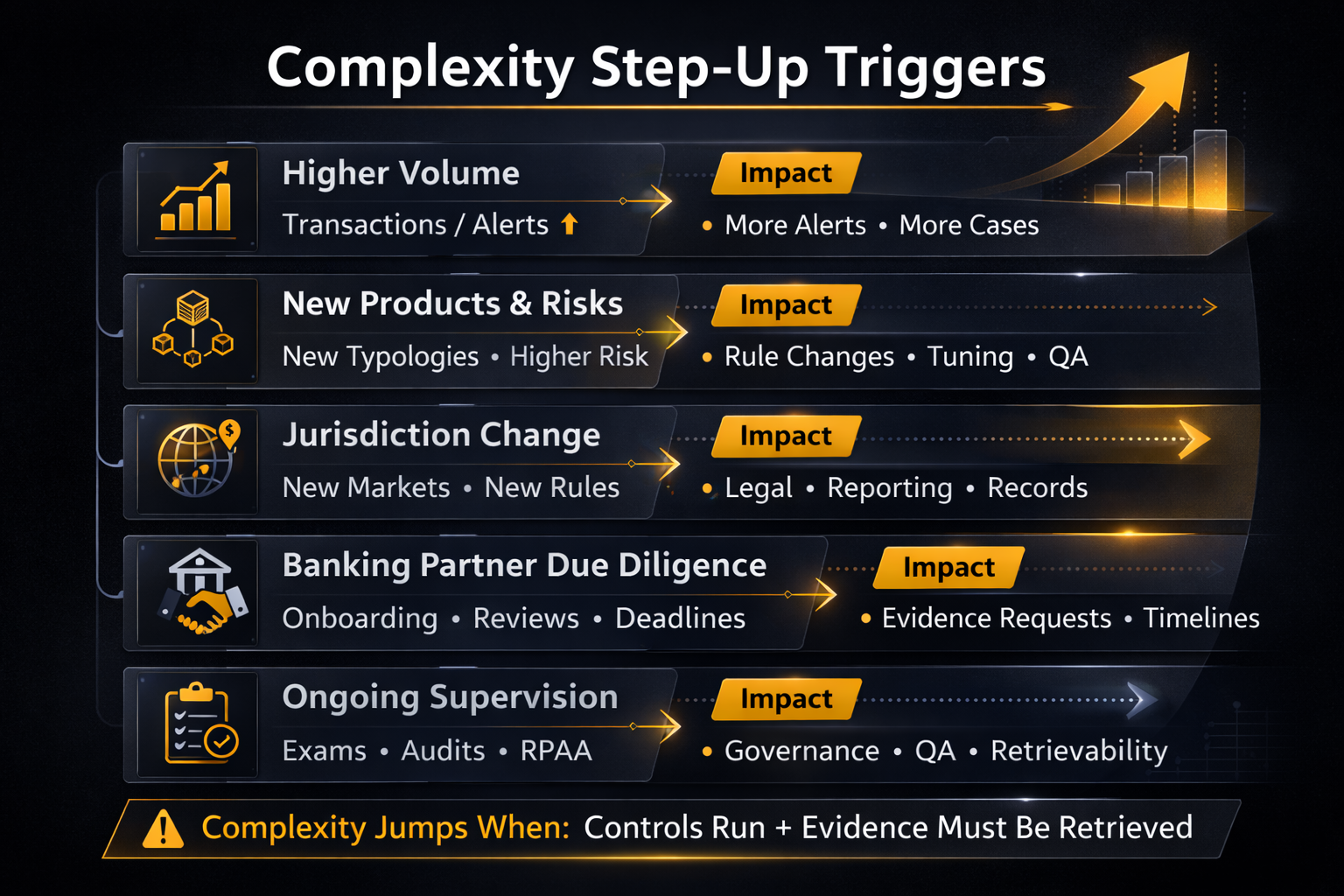
Compliance cost does not rise smoothly. It often jumps when complexity changes.
Common step-up triggers:
-
higher transaction volumes or higher alert volumes
new products that change typologies and risk assessment logic -
new jurisdictions with different reporting and recordkeeping rules
-
new banking partner requirements and due diligence cycles
-
supervisory frameworks that require ongoing governance and evidence, not periodic catch-up
AMLI Analysis: Complexity increases burden most through ownership, QA, and evidence standardization. Tools help, but they do not replace governance.
Example Budget Bands: Directional, Scope-Dependent
These bands are directional. They help founders and operators avoid under-budgeting by excluding ownership and evidence workload. They are not a quote and should be calibrated to jurisdiction, product risk, volume, and partner expectations.
1) Lean stage MSB or fintech (low volume, single jurisdiction)
Directional annual band: low five figures to low six figures (often driven by whether ownership is fractional or full-time).
Cost drivers: evidence set creation, basic screening, initial monitoring workflow, training records, and periodic readiness review.
Published software anchors show entry tiers can start around $99.99/month for self-serve plans with usage limits, while other approaches publish higher monthly starting points depending on included data and workflow tooling.
Common gap: no budget for QA sampling and evidence packaging.
2) Growing fintech (moderate volume, more change, bank due diligence)
Directional annual band: mid-six figures (common once alert operations, QA, and governance become consistent).
Cost drivers: accountable owner, analyst throughput, monitoring workflow maturity, tuning governance, and evidence retrieval readiness.
Common gap: tools are purchased, but case notes, escalation rules, and tuning decisions are not standardized.
3) High-scrutiny program (multi-jurisdiction, RPAA readiness, recurring review cadence)
Directional annual band: high six figures to seven figures (scope dependent, often driven by governance, assurance, and scale).
Cost drivers: senior accountable oversight, evidence architecture, recurring assurance work, incident readiness, and supervisory response capacity.
A practical signal that cost is moving upward is when your program must operate within a formal supervisory regime with registration and annual assessment fee structures.
AMLI Analysis: If evidence is scattered across systems with weak ownership, cost becomes unpredictable because every review becomes a rebuild.
Frequently Asked Questions
Q: How much does AML compliance software cost?
A: Published examples show a wide range. Some vendors publish self-serve starter pricing with usage limits, while others publish entity-based tiers or higher starting points depending on included data and workflow tooling. The correct budget depends on your volume and how much analyst effort each alert consumes.
Q: Why do compliance budgets spike suddenly?
A: Cost step changes happen when you must produce evidence under a deadline: bank onboarding, partner due diligence, audits, examinations, or rapid multi-jurisdiction growth. Retrieval speed becomes costly when evidence isn’t structured.
Q: What is the most common under-budgeted area?
A: QA and evidence systems. When evidence retrieval is slow, teams compensate with manual effort and external support, which drives recurring costs.
Getting Support
AML Incubator supports fintechs, MSBs, and PSPs with review-ready compliance operations, including RPAA registration support and Fractional CRO services designed for ongoing governance ownership.
-
Related blog (FINTRAC AMPs)
-
Related blog (RPAA overview)
Book a consultation to map the right roles, QA coverage, and evidence workflows for your stage.