AML Compliance 101 for Startups: What You Must Know
Startups in fintech, payments, and crypto often treat AML as a later problem. Regulators and bank partners treat it as an operating condition. AML compliance is an operating system that must match onboarding, payments, conversions, custody, and support workflows. The goal is defensible customer due diligence, meaningful monitoring, and evidence you can produce during review.
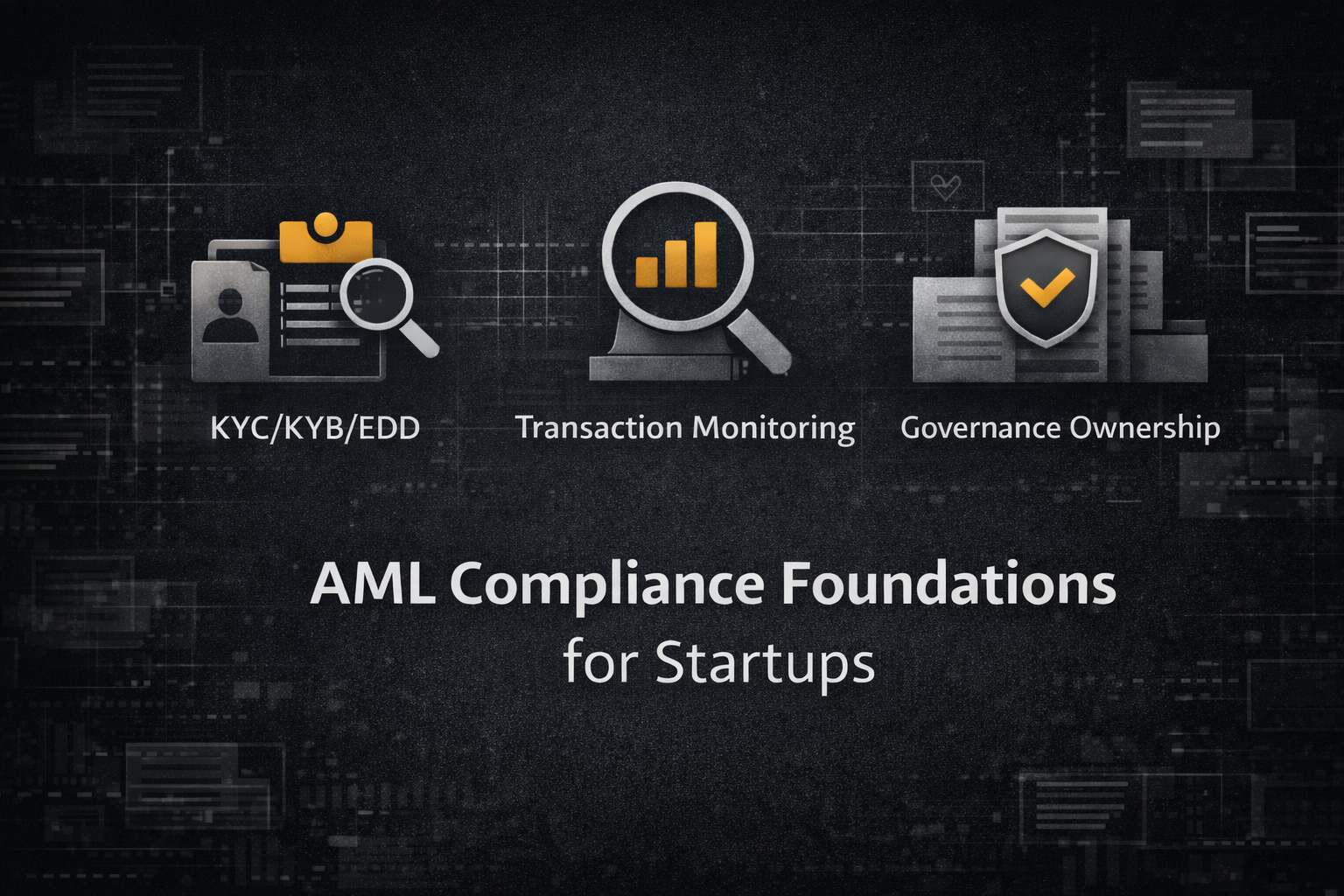
When startups start searching for AML compliance.
Startups usually search for AML basics at the point where money movement becomes real.
-
A bank partner or payment processor requests your AML program and evidence samples.
-
An investor asks whether you are in scope and how you manage financial crime risk.
-
Your product expands into payments, wallets, stored value, crypto, cross-border flows, or cash-out.
If your program cannot produce evidence, you will feel it through delayed partnerships, slowed launches, and failed due diligence.
AMLI Analysis: Most early teams underestimate two things. Scope determination and execution discipline. Partners and supervisors evaluate what you run in practice and not what you plan to implement.
What is AML compliance?
AML (Anti-Money Laundering) compliance is the set of controls used to prevent, detect, and report potential money laundering and terrorist financing risks.
For startups, an AML program typically covers:
-
Governance and ownership
-
A risk assessment based on the risk-based approach
-
Customer due diligence (CDD) and identity verification (often called KYC)
-
Screening where applicable (sanctions and politically exposed persons)
-
Ongoing monitoring of transactions and customer behavior
-
Investigation workflow, escalation, and reporting (jurisdiction-specific)
-
Recordkeeping and evidence retention
-
Training and periodic effectiveness review
Globally, AML systems are anchored in the FATF (Financial Action Task Force) standards and the risk-based approach, which the FATF describes as the cornerstone of its recommendations.
Jurisdiction note (Canada, United States, United Kingdom)
AML obligations are jurisdiction- and activity-dependent. Anchor your program to the rules that apply to your operating footprint and to the expectations of the partners you rely on.
-
Canada (FINTRAC)
FINTRAC (Financial Transactions and Reports Analysis Centre of Canada)’s compliance program guidance lays out core program elements (compliance officer, policies and procedures, risk assessment, training, and effectiveness review).
-
United States (FinCEN and the BSA (Bank Secrecy Act) framework)
If you are operating as an MSB (Money Services Business), FinCEN (Financial Crimes Enforcement Network)’s resources on MSB suspicious activity reporting are a practical starting point for understanding expectations and filing mechanics.
-
United Kingdom (MLRs (Money Laundering Regulations) and SARs (Suspicious Activity Reports))
UK guidance explains suspicious activity reporting expectations and the role of the National Crime Agency (NCA).
AMLI Analysis: If you operate across jurisdictions, you can keep one operating model, but you cannot keep one generic rule set. Standardize the workflow while mapping reporting triggers and recordkeeping to each jurisdiction.
Do startups need AML compliance?
AML obligations depend on what you do, where you do it, and how value moves through your product.
You are very much more likely to be in scope and/or to face partner-imposed AML requirements if you:
-
Move money or value between parties (payments, transfers, remittances)
-
Store value (wallets, stored balance, custody)
-
Enable conversion or cash-out (fiat-to-crypto, crypto-to-fiat, exchange, off-ramps)
-
Serve cross-border corridors or higher-risk geographies
-
Rely on regulated partners who require AML controls contractually
AMLI Analysis: Partner due diligence can be as operationally demanding as direct regulation. The review standard is evidence.
Scope confirmation method (how to confirm if AML applies)
-
Map your product flows in plain language
Describe how funds enter, move, convert, are stored, and exit. -
Check official regulator guidance for the activity category
For example, FINTRAC’s compliance program guidance is a clear baseline reference for program expectations. -
Confirm partner-imposed requirements
Banks, processors, and custodians often impose AML expectations even before licensing is triggered. -
Validate licensing and reporting triggers with qualified advice
This is particularly important when dealing with custody, conversion, cross-border transactions, or stored value.
KYC vs AML: What is the difference
KYC (Know Your Business) is usually one part of AML.
-
KYC (Know Your Client) often refers to identity verification and onboarding checks.
-
AML includes KYC plus monitoring, investigations, governance, reporting, and evidence.
There are more such requirements, such as KYB (Know Your Business) and KYT (Know Your Transaction).
For a deeper explainer, AMLI has a dedicated article on how KYC and AML programs work together.
The risk-based approach: The principle that controls everything
Most AML regimes are built, and should be built, on a risk-based approach. In practical terms:
-
You identify and assess ML/TF/SE risk. (Money Laundering/Terrorist Financing/Sanctions Evasion)
-
You apply controls proportionate to that risk.
-
You update controls as product scope and customer behavior change.
FATF positions the risk-based approach as the cornerstone of its recommendations and emphasizes proportionality and focus on higher-risk areas.
AMLI Analysis: “Risk-based” means defensible choices, documented rationale, and repeatable decisions.
What an AML program includes (legal requirements vs expectations vs best practice)
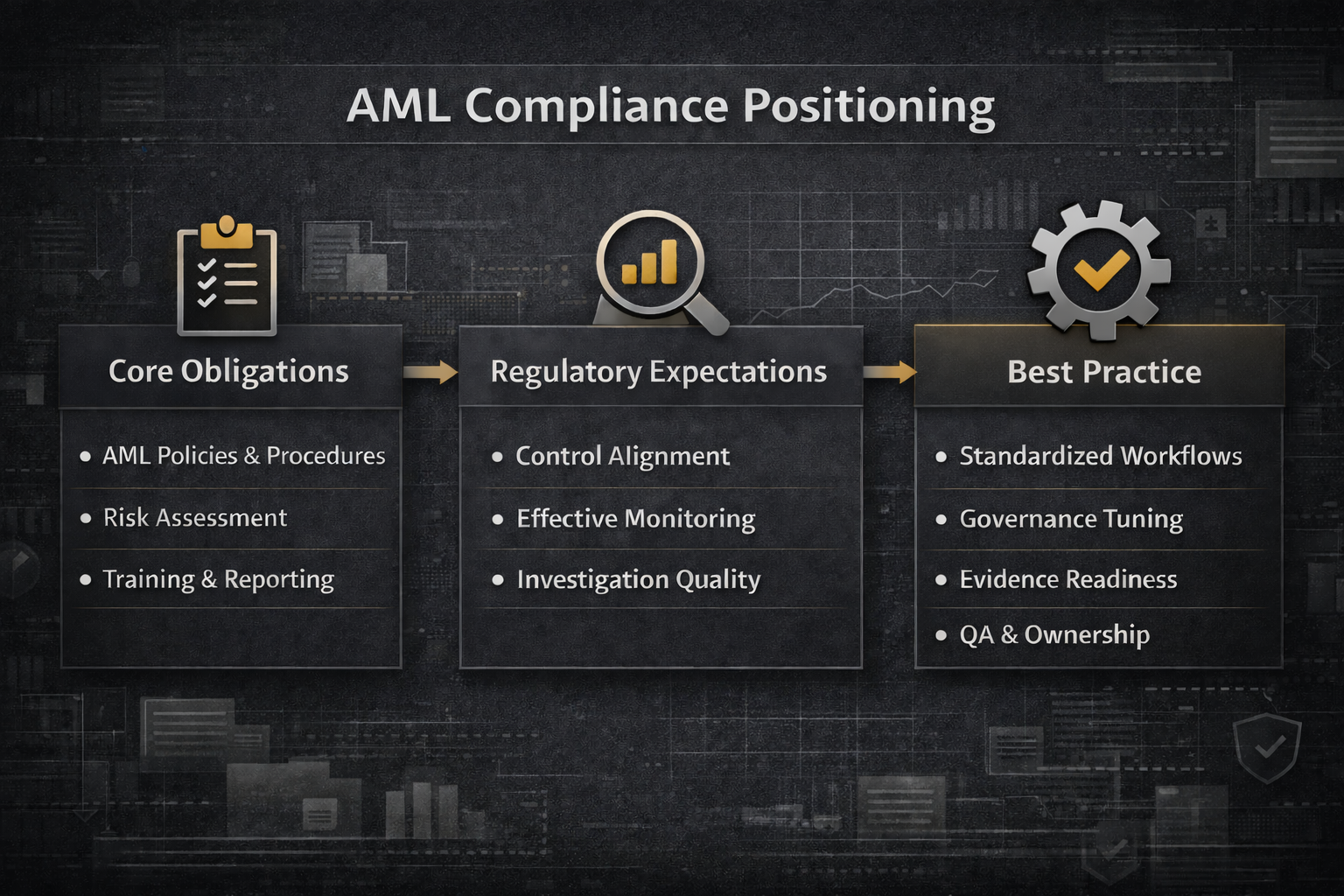
Legal requirements (typical program fundamentals)
Across many regimes, AML programs commonly require documented program elements and accountable ownership. FINTRAC’s compliance program guidance is a clear example of regulator-framed program fundamentals.
Regulatory expectations (what supervisors and partners test) |
Best practice (how strong operators reduce friction) |
|
|
|
|
|
|
|
|
|
|
Customer due diligence (CDD): What you must collect and what you must decide
CDD usually includes:
-
Identifying the customer and verifying identity to the required standard
-
Understanding the purpose and intended nature of the relationship
-
Screening where applicable (sanctions and PEP)
-
Assigning an initial customer risk rating
-
Defining refresh triggers so risk does not freeze at onboarding
AMLI Analysis: A customer can pass identity verification and still be high risk. CDD quality is measured by decision quality and documentation, and not vendor pass rates.
Business customers and beneficial ownership: The gap that breaks startups
If you onboard business customers, you need a defensible approach to:
-
Verifying that the business exists and is legitimate
-
Understanding the business model and expected activity
-
Identifying beneficial owners and controllers where required
-
Screening relevant individuals where applicable
-
Assigning risk based on industry, ownership complexity, geography, and transaction patterns
AMLI Analysis: Business onboarding failures are usually evidence failures. The business is real, but you cannot show control, rationale, or validation steps.
Sanctions and PEP (Politically Exposed Person) screening: What startups must not treat as optional
Exact obligations vary by jurisdiction and licensing status, but partners commonly expect:
-
Screening at onboarding
-
Rescreening on cadence or trigger events
-
Documented handling of potential matches
-
Escalation and approval rules for confirmed matches
AMLI Analysis: The operational risk is weak match handling. If you cannot show how matches were reviewed and cleared, reviewers assume the screening control is unreliable.
Enhanced due diligence (EDD): When it applies and what good looks like
EDD is triggered when risk is higher. Common triggers include:
-
Higher-risk geographies or cross-border exposure
-
Higher-risk sectors or typologies
-
Complex ownership structures
-
Unusual expected activity or rapid behavioral change
-
Elevated screening outcomes or adverse information indicators
EDD in operational terms means:
-
Collecting additional information appropriate to the risk
-
Applying stronger verification steps
-
Documenting rationale for acceptance
-
Applying tighter monitoring rules and review cadence
-
Obtaining senior approval where required or expected
Transaction monitoring for startups: How to think about it without overbuilding
A defensible monitoring system usually has:
-
Monitoring coverage aligned to your risk assessment
-
Defined alert logic with rationale and change control
-
Case workflow that produces consistent notes, decisions, and approvals
-
Escalation rules and reporting workflow tied to your jurisdiction
-
Backlog standards (aging limits, prioritization, staffing triggers)
-
QA sampling to test consistency
Monitoring categories are not universal rules. They are common areas that firms evaluate and adapt based on product exposure, customer types, and typologies.
AMLI Analysis: Alert volume is not effective. If you cannot close cases with consistent notes and a defensible rationale, the control is weak even if the tooling looks sophisticated.
Case management and investigations: The standard most startups miss
Minimum expectations for case notes:
-
Why the alert fired (context, trigger, and what it detected)
-
What data was reviewed (transactions, onboarding profile, counterparties)
-
What explanation was considered (expected vs observed activity)
-
What decision was reached (close, restrict, escalate, report)
-
Who approved and when
-
What follow-up actions were taken (EDD, limits, enhanced monitoring)
AMLI Analysis: Weak case notes are a universal red flag in due diligence reviews. They signal decisions are not repeatable, and controls are not governed.
Recordkeeping and evidence: The minimum evidence pack must be review-ready.
"Review-ready" means you can produce a coherent, dated evidence set quickly without reconstructing history.
Minimum viable AML evidence pack for startups:
-
AML policy and procedures aligned to the current product scope
-
Roles and responsibilities, escalation path, approval authority
-
Risk assessment tied to product flows and customer base
-
Customer risk methodology, including EDD triggers and refresh triggers
-
CDD procedures for individuals and businesses, including the beneficial ownership approach where relevant.
-
Monitoring coverage inventory and change log
-
Case notes standard and sample case files showing quality
-
Backlog ageing standard and prioritization rules
-
QA plan and QA sample results
-
Periodic effectiveness review plan
-
Findings log and remediation tracking with owners and deadlines
For example, FINTRAC's compliance program guidance ensures the existence and maintenance of key program elements.
What banking partners and regulators actually test
Most partner due diligence and supervisory review concentrates on five themes:
-
Scope and classification rationale
-
Risk assessment credibility and update discipline
-
Control alignment to product reality
-
Monitoring outcomes and investigation quality
-
Evidence and governance ownership
AMLI Analysis: The most common gap is a mismatch. Policies describe an ideal process. Operations run a different process. Evidence exposes the difference.
Execution Reality: A Practical Weekly AML Routine for Fintech and Crypto Startups
A maintainable weekly cadence:
-
Review onboarding escalations and document decisions
-
Review the monitoring backlog and alert for aging.
-
Run QA sampling on closed cases and record findings
-
Update monitoring logic through a controlled change process
-
Apply risk refresh triggers to customers with changing behavior
-
Update the issues log and track remediation to closure
Frequently asked questions
Q: What documents do we need for AML compliance as a startup?
A: At minimum: AML policy, risk assessment, CDD and EDD procedures, business onboarding and beneficial ownership approach (if relevant), monitoring coverage inventory and change log, case notes standard and sample case files, training records, effectiveness review plan, and remediation tracking.
Q: Is using a KYC vendor enough?
A: No. Vendors support controls. Accountability stays with you. FINTRAC’s guidance is explicit that responsibility for implementation remains with the reporting entity and the compliance officer role, even if duties are delegated.
Q: What happens if we ignore AML until later?
A: In practice, the pain shows up through partner friction, delayed launches, failed due diligence, and forced retrofits when volume makes reconstruction unrealistic.
Getting support
If you are building a regulated product, the fastest path is usually a program that is operational, review-ready, and maintainable by a lean team.
Book a consultation to review the scope, control gaps, and what a maintainable AML operating model should look like for your product and jurisdictions.
Explore More Articles
The Cost of Compliance: Market Salaries, Software Pricing, and Review-Ready Budgets (2026)
24.02.26
Third-Party Service Providers under RPAA: Vendor Oversight, Operational Rist, and Incident Response
10.02.26
FINTRAC Supervision Now Has a Price Tag: Why You’re Getting Invoiced (and What It Means)
05.02.26